WORMS 10 in Colour: Torrey Peters
Pigs, Sisterhood, and the Shape of Desire
Torrey Peters reflects with P. Eldridge on writing in Colombia, the politics of trans art, lumberjack alter-egos, and the many forms of love that underpin queer life and literature.
Interview by P. Eldridge
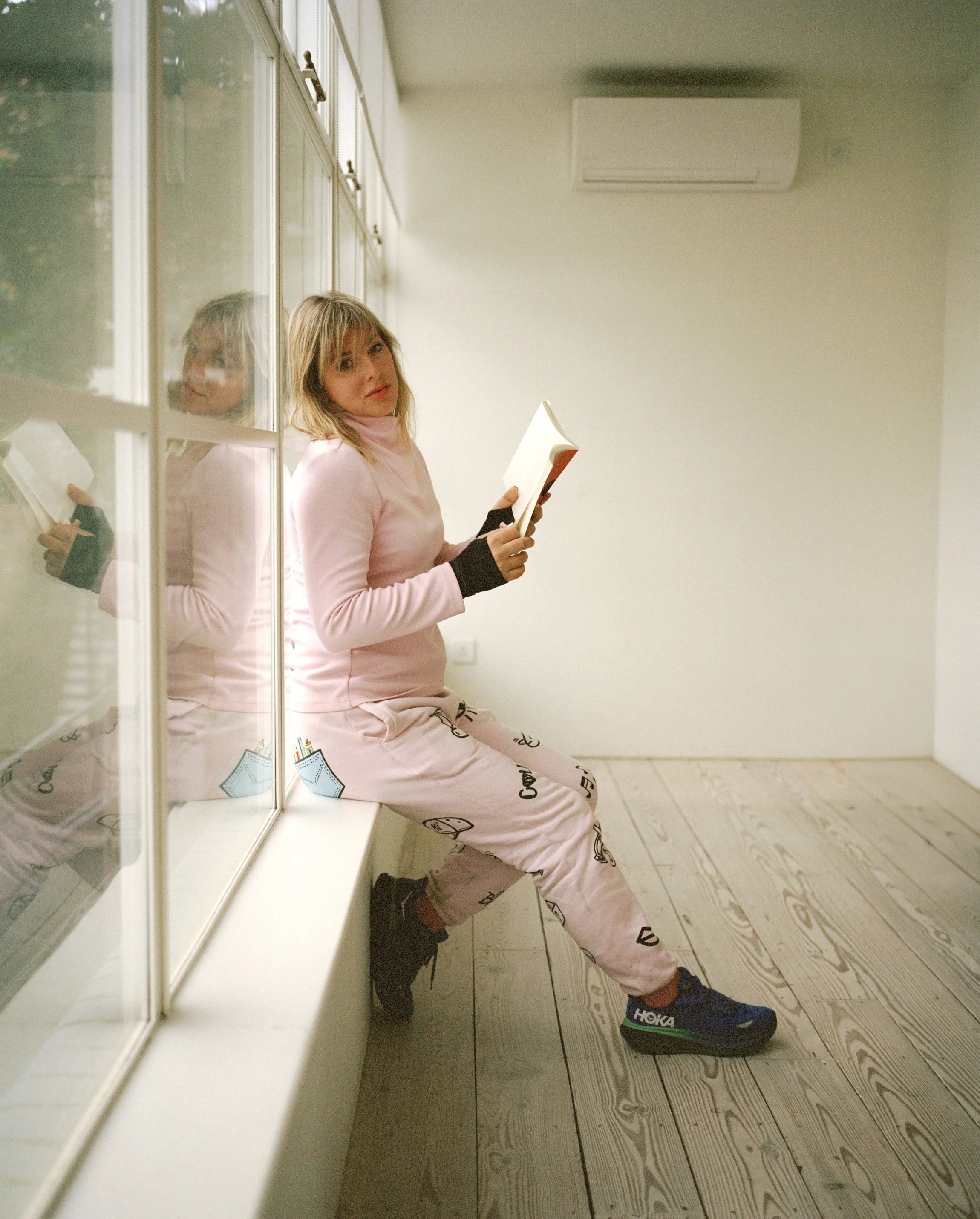
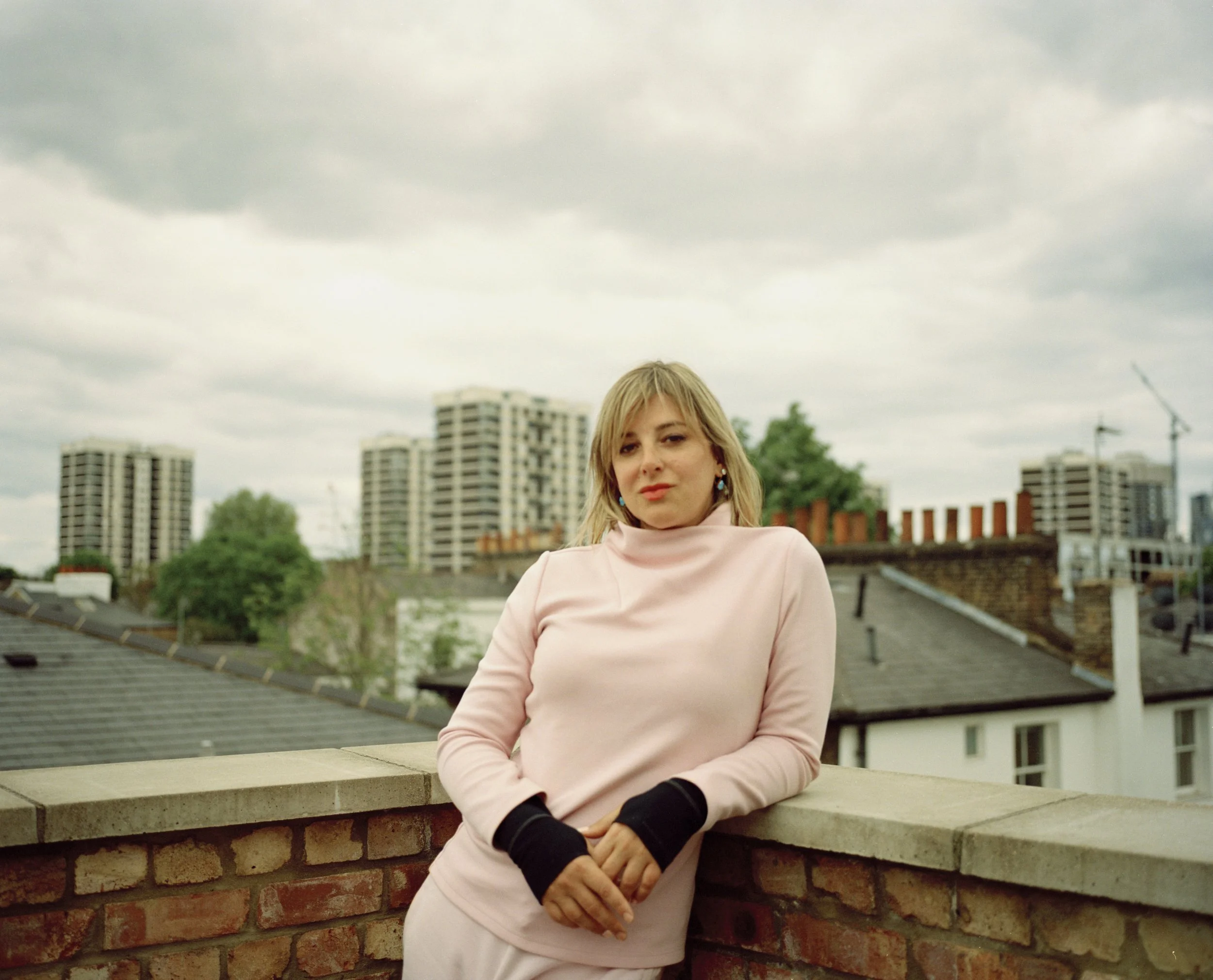
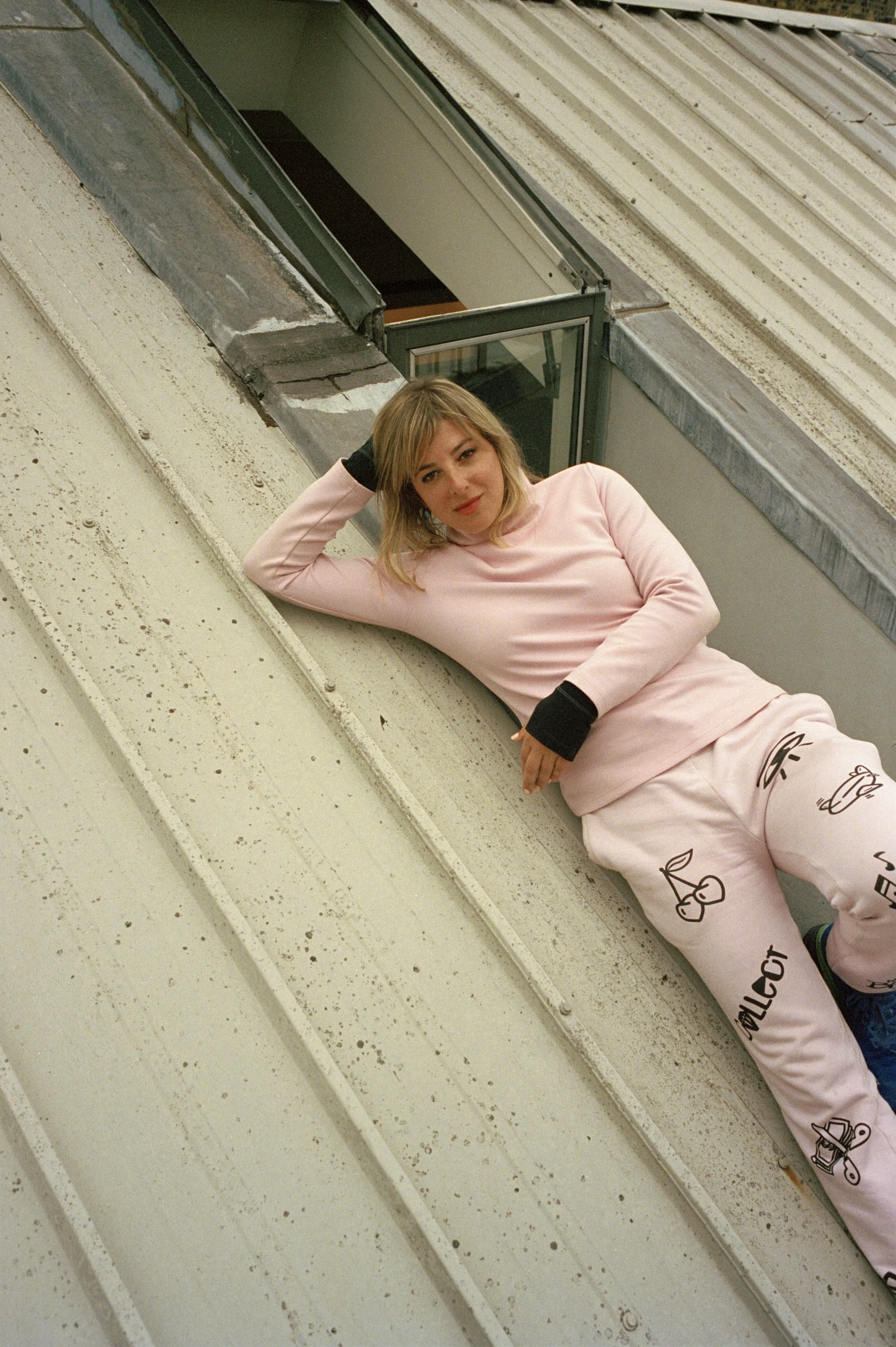
Photos by Sophie Williams

I’m sitting cross-legged on a sofa next to Torrey Peters, the late afternoon light slanting across the room as we settle into conversation. There’s a disarming ease in the way she speaks: thoughtful, incisive, and often wickedly funny. We begin with Colombia; not in abstract terms, but in the very real, very lived sense of Santa Marta, where she now spends her winters writing and reflecting on America from afar. What follows is an expansive, roving conversation that moves fluidly between literature and life: on writing from exile, the cultural battleground of trans visibility, and the strange intimacy of gender performance. We soon turn to Stag Dance, Peters’ recent novella and the centrepiece of her new collection of novellas. Set among a rough-and-tumble group of lumberjacks in the northern wilderness, ‘Stag Dance’ is both tender and unflinching; a mythic yet deeply human exploration of desire and performance. In it, Peters constructs a world where the hypermasculine becomes elastic, almost surreal, allowing her characters to navigate identity with both ferocity and vulnerability. It’s a story that complicates any easy reading of gender or power, while also delivering the rugged, erotic charge of bodies in motion; chopping, dancing, needing. As with much of Peters' work, there’s a destabilising humour beneath the surface, inviting us to question not only what masculinity looks like, but what it feels like to live inside its performance. With characteristic wit, Peters speaks on the politics of trans art, the freedom found in lumberjack alter-egos, and the surprising forms love can take. At the heart of it all is her enduring belief in fiction not just as a form, but as a way of making sense of obsession, of desire, and of how we live through and alongside one another.
The following is an extract from the full feature interview in Worms 10: The Love Issue. If you would like to read the full interview, consider becoming a member at the link below or purchasing your very own copy.
P. Eldridge: How's Colombia been?
Torrey Peters: It's good. I'm married and my wife has always liked going, she has sabbaticals there. We went in 2022 and I just fell in love with this town, Santa Marta. I had a sense that there was a fascist turn in the United States coming and I wanted to spend more time outside of the country. I was always going to write about it, but I wanted to look at the United States from the outside. I think there's a way in which many writers oftentimes do some of their best work in exile, beyond the maelstrom of daily bullshit.
I think Ethel Cain was saying something similar recently, she had to take herself away to write.
Similar to Baldwin going to Turkey. It’s interesting, there’s a strong tradition of writers working in exile in Latin America; a bit different from what you often see with American writers. American authors tend to stay in the U.S. or move around within it, but many of the great works of Latin American literature were written outside their home countries. Even One Hundred Years of Solitude by Gabriel García Márquez was written in Mexico City. I’ve been spending every winter for the past four years in Santa Marta for similar reasons.
With everything happening in the U.S. right now, it's kind of difficult to know where the safe places are.
Colombia obviously has problems, but there’s a conversation happening on terms that I appreciate. There was a really terrible transphobic murder a couple of weeks ago.
Yes, Sara Millerey.
There are transphobic murders all over the world, but what’s rare is that the president of Colombia explicitly called transphobia fascism. The attack itself was horrific, of course, but what stood out was the response. Politicians often meet these moments with silence. So for the president to publicly name it as fascism and say it wouldn’t be tolerated, that says something about where the conversation is in Colombia right now.
It's very moving to hear a leader say that.
Knowing it’s bad and choosing to have the conversation is moving. There was a terrible transphobic crime outstate New York, not far from Brooklyn, and the politicians were totally silent. I think the difference in having a conversation is pretty huge.
It's monumental.
Colombia is great, I love it. I want to start my next book and I think that I will go to Colombia to begin. I don't want to look like I'm running away from all the shit happening in the United States. I want to be in the fight, but I also think as an artist there's maybe a place for exile occasionally.
Will you write a novel?
I’ve wanted to write a long novel for a while, but with the reception to Detransition, Baby I got some screenwriting work which made me too frenetic. The lumberjack story, ‘Stag Dance’ is a reaction to Detransition, Baby and its reception. But I have had an idea for a novel that will require pretty sustained focus over a period of time, which isn't that easy to do. Right now in the U.S., every day is a new distraction, which is intentional. All of Trump's executive orders are distractions meant to stop people from being able to collect themselves and produce things.
It's like war, right? If you keep assaulting the opponent, they won't have time to materialise resources or build a collective unit to respond.
Yes. For me, it's about the sustained effort it takes to be a novelist, not just a writer, but a novelist in particular. Novels are works that take time, you have to work slowly, and I’m learning that to write a novel requires creating space for yourself where you can write for four hours a day, multiple days a week, and also keep that space, that headspace of your novel, open. Then switching into any other kind of mode, whether it be selling a book, the publicity tour—that part of your brain—or whether it be reacting to the indignities and insults of our current political moment, really take you out of that. So much of Colombia for me is about figuring out I don't just want to be a writer, I want to be a novelist. Being a novelist means not just writing one novel once, but figuring out how to continue living a lifestyle that allows for writing novels in the future.
Is that difficult money-wise?
I'm married to a law professor. [Laughter]
Aha, I see! [Laughter]
She's into it, it’s our dynamic.
It’s cool to have that policy mindframe as well.
How so?
To be in relationship with that as a novelist.
Yes! Her expertise is debt. Specifically, how debt operates from a leftist perspective, and how it functions structurally in the United States. In my next book, I want to explore political economy as part of the world I’m building. My shorthand for what I’m trying to do is something like Wolf Hall by Hilary Mantel or A Brief History of Seven Killings by Marlon James; books where the characters aren't just making isolated personal decisions, but are making choices within dense cultural and economic systems. In James’s case, it’s about gang dynamics in Jamaica and the cultural weight of Bob Marley; in Mantel’s, it’s the political maneuvering around the Tudors and the Catholic Church. Those books situate people inside their historical and institutional realities.
Similarly, I don’t think it’s an accident that trans people are at the centre of politics right now. You could say, cynically, that it's just because we're a small, vulnerable minority, and scapegoating minorities is a time-tested political strategy. But I don’t believe trans people were chosen at random. I think trans people are articulating—through our lives, through our art—radically new ways of living and thinking that are increasingly resonant with broader global shifts.
These connections are hard to trace directly, which is partly why people are always asking: Why is everyone so obsessed with trans people? But to me, I see someone like Elon Musk onstage with a chainsaw and think, This is gender performance. And it’s a failed one. It’s tied up with a hunger for money, for dominance, for some old ideal of masculinity that’s clearly cracking under pressure. What makes trans art so potent—and so threatening—is that it often has a language for exactly those tensions.
There’s this tangled web of issues: bodily autonomy, the logic of transformation, how the body is acted upon, and it connects to everything from Ozempic to abortion rights to the broader collapse of social institutions. Trans people have already been living through institutional failure for decades. We've had to build our own systems, create new ways of being outside existing frameworks. I don’t quite know how to explain all of it yet, except maybe by writing fiction that can hold and weave together that whole matrix of connections. I won’t be able to explain it clearly until I write the novel that brings it all into form.
You can really feel it in the first novella, ‘Infect Your Friends and Loved Ones’, with how the dystopian world has normalised the need for hormones. Of course, it’s the fallout of the dystopia that creates that need, but what’s striking is how deeply and urgently people come to rely on hormone replacement therapy. Even five years after the contagion, there’s this quiet desperation; it’s become a basic, almost unquestioned part of survival.
I didn't do a tonne of world building in that story on purpose. I wrote it in 2016.
Before Detransition, Baby?
Before. At the time, I was mostly interested in my relationships with other trans women, and that's largely what I think that story is about with a dystopic backdrop or conceit. Everything in that story has come true in a number of different ways including the pandemic. On one hand, it's not like I'm saying I predicted the pandemic. But the other thing is that the emphasis on, let's say cis men taking testosterone as a cultural signifier and the way that testosterone has become a valued commodity in relation to oestrogen which is not at all valued, has only gotten more prevalent in the last ten years.
“I think trans people are articulating—through our lives, through our art—radically new ways of living and thinking that are increasingly resonant with broader global shifts.”
There’s this bizarre meme culture among certain masculine creators that really captures what you’re referring to. You’ll see them in supermarkets, daring each other not to touch receipts because they believe it will lower their testosterone. It’s just one of the many absurd layers in the ongoing performance of masculinity.
I got fascinated looking at weightlifter hormone cocktails with adrenal or stuff like that. Also the ways that they present the cocktail, the ingredients they include, and why they think it actually makes them men. I don't think that stuff was happening as vividly and perhaps as readily in 2016… I’m sort of in a digression here.
Not at all, it's nice to spiral, isn't it?
Yes, it is. The plan is to try and write a novel that contains some of these connections.
Some of those connections are revealed in the questions you ask in your stories. The first that jumps out for me is Raleen from ‘Infect Your Friends and Loved Ones’, when she says, “I was thinking that I want to live in a world where everyone has to choose their gender.” It reveals choice…
It’s kind of ironic—even a bit of a joke—when she says that, because we already live in a world where everyone is constantly choosing their gender. Every morning, you get dressed and decide: what am I going to wear? How am I going to style myself? Those are gendered choices. We’re all doing it. The difference is that people panic when that process is made explicit to them, when they’re forced to acknowledge that gender is something they’re actively performing.
That ties into the broader question: why is everyone freaking out about trans people? Well, it’s because our presence makes that process visible. Trans people reveal that gender isn’t innate or fixed – that it’s something constructed and maintained. When I, as a trans woman, do the things that make me a woman, they’re often the same things cis women do. That realisation can be destabilising; suddenly, some cis women might ask themselves, Are all the things I do to be a woman artificial too? But it’s not about being artificial. It’s that there’s no fundamental difference between what trans women do and what cis women do to be perceived as women.
That discomfort—that existential panic—is really what ‘Infect Your Friends and Loved Ones’ is about. The dystopia in that story doesn’t come from a virus or a natural disaster. It comes from people collectively losing their minds over having to confront a truth they didn’t want to deal with. Society collapses not because of the disease, but because of the refusal to think. Which, to me, mirrors what’s happening right now: people are so desperate to "end" transness that they’re willing to burn everything down—the economy, the planet—just to avoid facing the reality that gender is something we all construct.
So… you’re obsessed with pigs. [Laughter]
[Laughter] I'm not totally obsessed with pigs. I think it's fun when authors have a thing that you're just like, Why do they do that?
There’s something else you do in your writing, you always describe the feeling, texture, or smell of the air.
Interesting.
In ‘Infect Your Friends and Loved Ones’, you noted the air smelling fecund and the breeze carrying a note of green. In ‘Stag Dance’ you write, “the air smelled Christmas.”
I’ve never had anyone point that out to me.
[Laughter] Spotting the pigs is much more obvious.
[Laughter] I was thinking about how in a Haruki Murakami story, it’s a cat, a butterfly, music. I thought, I'll just do pigs. My joke is that the stories are ordered from most pigs to least pigs. They're literally in that order, for different reasons of course, but this is my go-to shorthand in the stories: pigs.
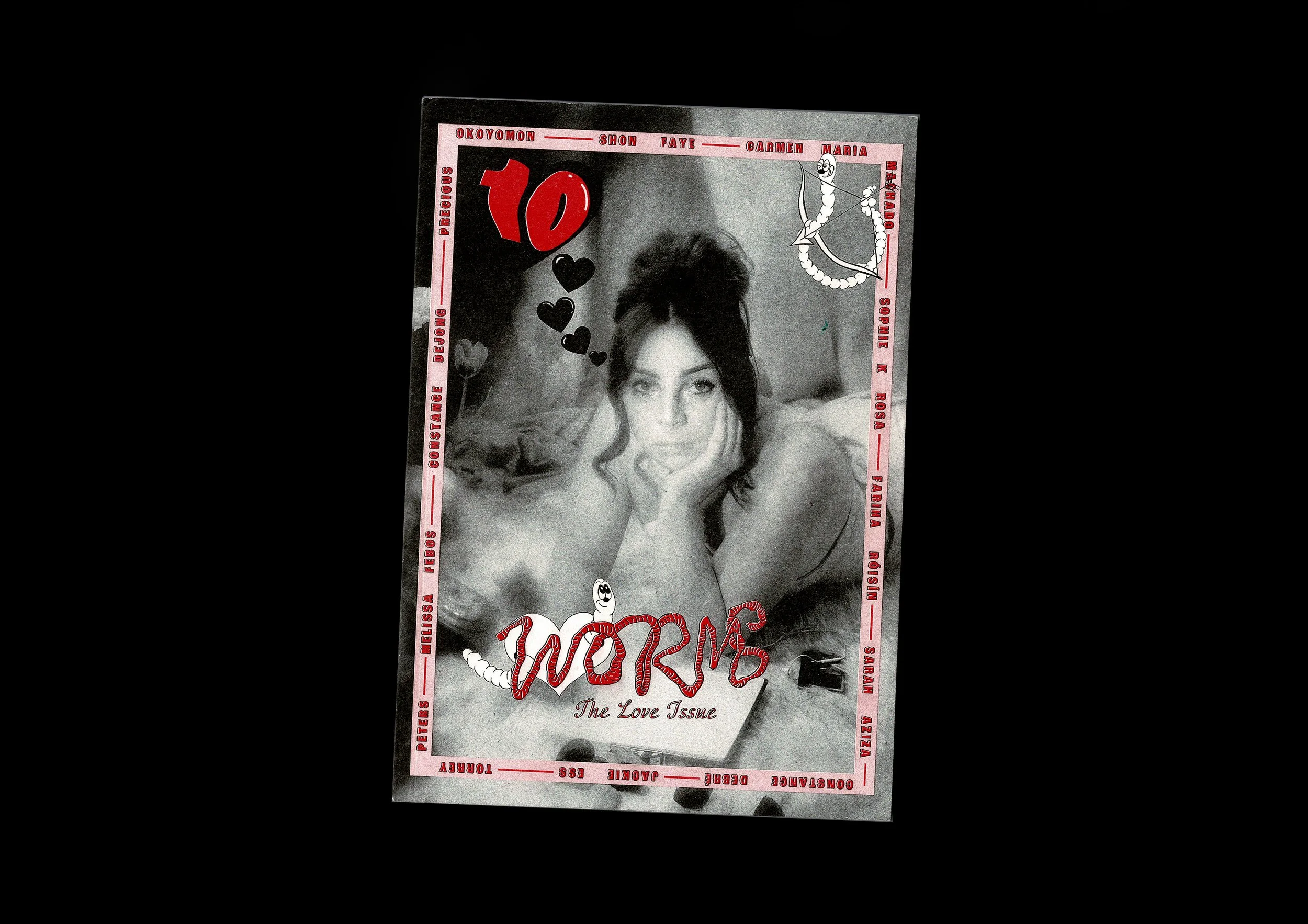
We’re SO excited to announce our return to print with Worms 10: The Love Issue, available now ♥️
This latest issue of Worms invites readers into a bold and tender exploration of love in all its messy, political, and transformative guises.
Set against the backdrop of state-sanctioned transphobia in the UK and US, ongoing genocide in Gaza, and a litany of global injustices that see us staggering under the weight of collective and personal upheaval, this issue reckons with thinking and writing about love in a time of crisis. How do we take seriously the seemingly frivolous demands of love, devotion, beauty—in all their myriad and sometimes painful forms—when basic needs and rights are stripped away.
Featuring voices from at home and overseas including Shon Faye, Torrey Peters, Melissa Febos, Constance DeJong, Sarah Aziza, Precious Okoyomon, Carmen Maria Machado and Constance Debré, as well as contributions from rising stars in experimental literature, we ask: How can we continue to love someone who refuses to change? Is writing about sex still strange – or have we done and seen it all? What do you do if you fall in love with your sperm donor?
From the resilience and fierce creativity of trans writers, the challenges and ethics of telling love stories that are not our own, to the guts and gristle of motherhood, pet love, age-gap relationships and getting off on poetry, Worms 10 is a testament to the power of writing, and of love, as acts of resistance, reclamation and truth.
FEATURING: Shon Faye, Jackie Ess, Precious Okoyomon, Constance Debré, Melissa Febos, Torrey Peters, Carmen Maria Machado, Sarah Aziza, Constance DeJong, Sophie K Rosa
CONTRIBUTORS: Caitlin Hall, Zara Joan Miller, Devki Panchmatia, Lu Rose Cunningham, Gabrielle Sicam, Aimée Ballinger, Mimi Howard, Enya Ettershank, Sufjan Bile, MK McGrath, Amie Corry, Dizzy Zaba, 2ly (Molly Cranston, Safiye Gray, Hanako Emden, Sophie Florian, Johanna Maierski), Jemima Skala, Fariha Róisín, Summer Moraes
PHOTOGRAPHERS: Minu, Dozie Kanu, Jen Dessinger, Karla Monroe, Sophie Williams, Ellen Stewart
ILLUSTRATORS: Rifke Sadleir, Chloe Sheppard, Charlotte Pelissier, Leomi Sadler
EDITORS: Caitlin McLoughlin, P. Eldridge, Clem MacLeod, Arcadia Molinas
DESIGN: Caitlin McLoughlin
Publication date: July 2025
Published in the UK by Worms World C.I.C.
Magazine | Paperback
240 × 170 mm | 184 pages
BECOME A FULL TIME WORM MEMBER…
Becoming a FERTILISER gives you full access to all of our digital content via the Wormhole, including extended reads on special features, exclusive newsletters, access to our archive, and reviews and recommendations from the Worms team. £3 per month OR Save 25% with an annual subscription for £27
