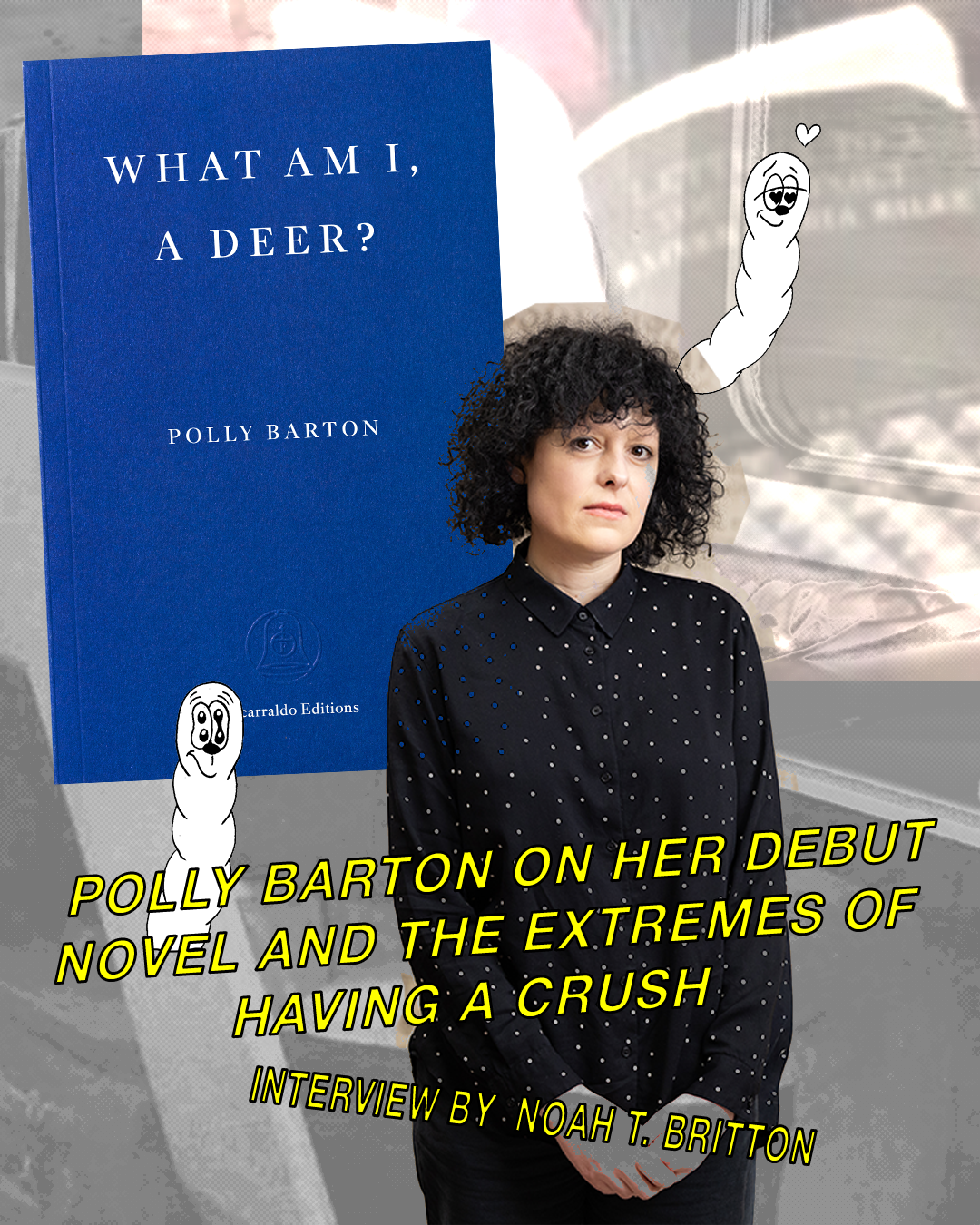
Polly Barton on her Debut Novel and the Extremes of Having a Crush
Interview by: Noah T. Britton
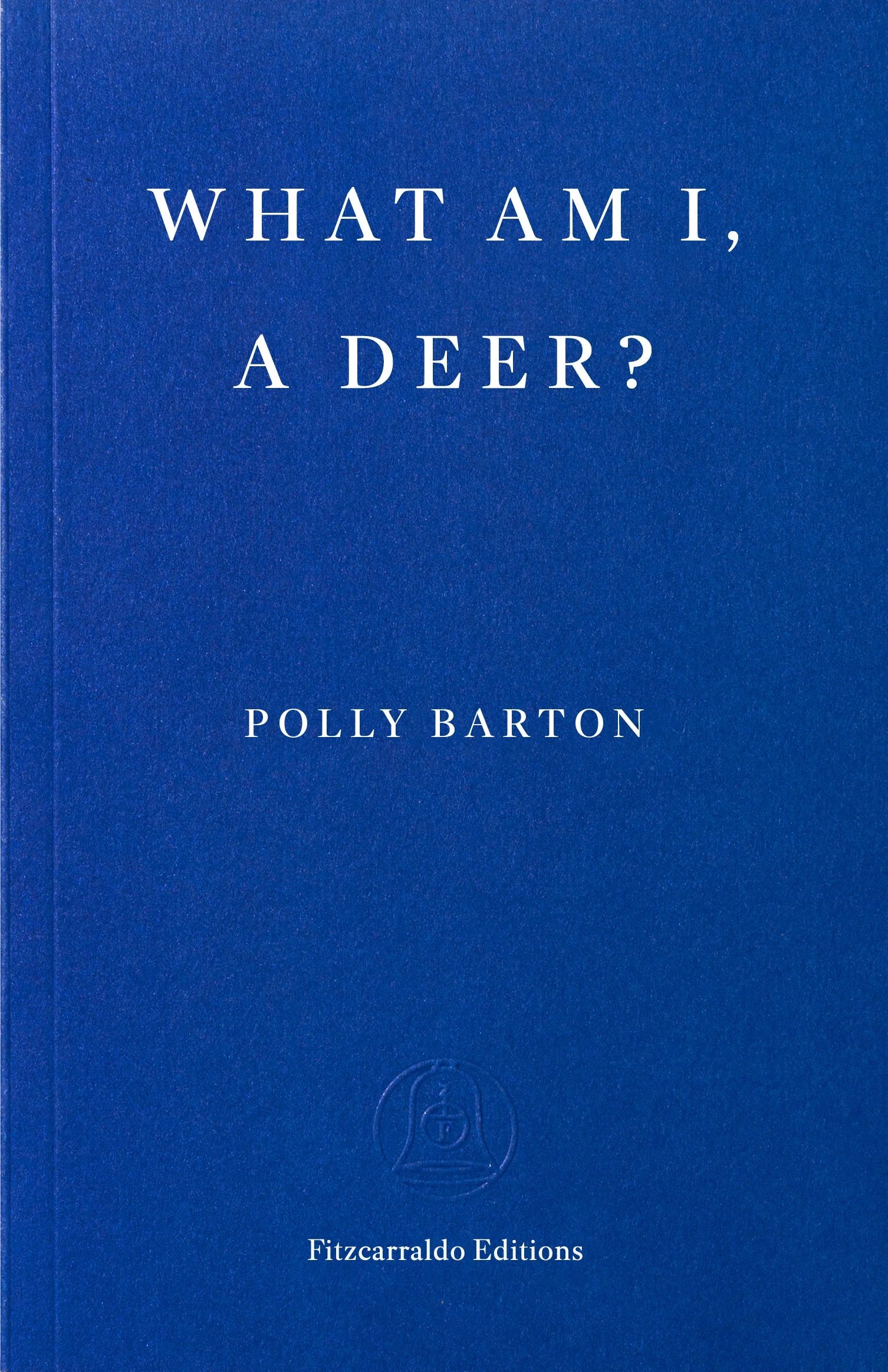
Here, as in her debut novel, Polly Barton makes a distinction between “being in love or thinking you are.” That near slip—the thing like love—sets up the illusion in What Am I, a Deer?, in which the main character agonises over feelings for a colleague, both of whom are never named. The novel’s heightened sense of desire is steadied by an exact depiction of everyday life and the various ways we are alienated from ourselves: mindless commutes; the minor stakes of the workplace; and the more elusive questions of belonging that tug at the main character’s Jewish lineage. Karaoke stints to Cyndi Lauper offer the only release, a kind of artificial escape made real through belief—like a crush. Love, like any interlude, is sometimes clarified through dissonance, scaling the space between who we are and who we imagine ourselves to be.
Noah T. Britton: I wanted to start with a question about your process. What is the experience of writing for you?
Polly Barton: I think for the most part I write relatively fast, then come back and rehash in a more painstaking way. I feel as though the principle of write fast, edit slow is not too far in spirit from write drunk, edit sober? With this book especially, the first bits I wrote were the most tonally intoxicated, stream-of-consciousness-y parts, which require pace to write. For the rhythm, certainly, but also as a means of accessing the deeper reaches of the consciousness. But then the development of the draft as a whole is more gradual. There were scenes that I wrote four or five times over—sometimes without realising I’d done so.
Was there a particular moment where the story became a novel to you, and not just an idea?
I’d been having ideas about writing it swilling around for a while. It was while I was away on a residency in Cove Park that I sat down and wrote the prologue. That was one of the few writing experiences I’ve had when I’ve felt as though I was channelling something. I just sat down and wrote it non-stop, and then half an hour later, I was like, Oh, I guess I’ve got a thing. I didn’t yet know how it would fit with the rest, but then a couple of days later, I wrote the long crazy rant about karaoke boxes in Japan, and it felt to me that between those two, there was too much momentum to ignore any more.
You write about a “lightning strike moment” when your characters first meet, “a stale metaphor if ever there was one.” As you wrote into this romance, how did you avert or embrace clichés?
I think what I wanted to really tap into was the sense of romantic feelings being clichéd, because they are such a universal facet of human experience, and also because we have created these narratives around romance that serve as socially self-fulfilling prophecies, or at least to enforce the sense that you’re Doing The Right Thing, that you’re On a Path That’s Taking You Somewhere Good. So one of the thrills of being in love or thinking you are is feeling yourself to be partaking in some kind of archetypal experience that binds you to humanity. The effect being that when they’re in love, even quite cliché-averse people will tend to shed their aversion, and positively celebrate that communality, because the experience of being in love has made them lose their insistence on uniqueness and superiority.
“one of the thrills of being in love or thinking you are is feeling yourself to be partaking in some kind of archetypal experience that binds you to humanity.”
Back when I was writing my first book, Fifty Sounds, I pored over Barthes’ A Lover’s Discourse, which really left an impression on me: It made me think about this strange relationship between universality and particularity, and how when you’re in love with someone or obsessed with them, you don’t see these things as contradictory, necessarily, because you feel seen, and happy for your story to be part of a larger story, you know? The avoidance of cliché is the part that’s rejecting connection with the wider world, or at least connection that feels inauthentic. And that’s the narrator’s struggle: This desperation to find connection that doesn’t feel inauthentic, and compromising, and yet finding herself drawn toward these connections that by definition are inauthentic because they’re unilateral, even if they feel ever so intense and real. So I wanted to write love with a consciousness of that dance. All those dances.
I wanted to ask about the physicality of your writing. In Fifty Sounds, you talk about the “somatic aspects of Japanese mimetics,” how “language is something we learn with our bodies…” I’m always struck by your descriptions of a particular feeling – there’s something surprising to me in your phrasing, which also feels more precise. In Fifty Sounds: “I began to stab myself with a question…” Or in What Am I?, there’s a moment when an off-colour line from a boyfriend leaves the main character with a “yellow biliousness.. Could you talk me through how you achieve that embodied quality in your work, and how your translation practice informs your style?
I suppose the thing to stress first and foremost is the importance of really feeling whatever I’m writing about, really feeling like I’m there. I can’t really write unless I’m in that space. I think this is why I’m reluctant to write about anything that feels too far from me and my lived experience. It feels to me that having something new to say about something has to be premised on describing it in a way that feels truly evocative or encapsulating: The description as the transportative spell, which is what opens up the possibility of interesting things happening.
I was reading a Japanese essayist yesterday who was saying that philosophers and poets are united in their aim: to look really hard at things, to see them really well. And I think that for me, the process of having something substantive to say, or really just the impetus to write about a particular experience, necessarily involves describing it in a way that feels accurate on an embodied, phenomenological level – I can’t just be making an abstract pronouncement about it, even if that’s the eventual denouement. But is my slightly left-field phrasing just a result of a sensibility that’s inherently different to other people’s? No, I don’t think so. I think, like you imply, that there’s almost certainly some interference there from the experience of learning Japanese, and interacting with it and making it into English (whatever that means) all day long, this prolonged exposure to the in-between spaces in languages and maybe most particularly to first-draft English, before it’s been made palatable and is still quite literal, that has probably shaped in some quite fundamental way how I see language and what I respond to in it. I notice recently that I’m increasingly sceptical of beauty and lyricism.
“the thing to stress first and foremost is the importance of really feeling whatever I’m writing about, really feeling like I’m there. I can’t really write unless I’m in that space.”
Music, especially the experience of karaoke, plays a major part in this book. Did you listen to any particular music as you wrote? And did you turn to any music criticism or writing in particular for this novel?
I live next to a park, and I take a lot of walking or running breaks when I’m writing. I listened to a huge amount of music in those breaks, partly in search of suitable lyrics, but also just to put me in the headspace, open up the appropriate channels. There’s a playlist I’m hoping to release, containing a lot of the music that was behind the scenes as well as that which made it in. Bookwise, Carl Wilson’s 33 1/3 about Let’s Talk About Love (he’s more or less the only person to have written about an album he loathed), which really goes into it about bad taste and cultural capital, and then the expanded version of that, Let's Talk About Love: Why Other People Have Such Bad Taste, featuring essays by various people, were pretty influential.
I’m thinking about how much of the protagonist’s life is shaped by work: her move to a new city and her routines in the office, which is also the source of both her love interests in this book. How did you approach the workplace as setting, as an impetus for the narrative?
The first translation I ever pitched from scratch was a book called There’s No Such Thing as an Easy Job by Kikuko Tsumura. It’s a book that takes place entirely in the workplace, and we know nothing about the protagonist’s personal life. There was something about the combination of the tension and surface formality with the utter bonkerness of it that I lost my mind for, and which felt like such a true portrayal of what office life is like. Simultaneously sterile and anything but. Since then, I’ve thought a lot about the richness of the workplace setting in general, but I was particularly keen on exploring it as a fecund petri dish for a crush, which I’ve always found it to be.
“this prolonged exposure to the in-between spaces in languages and maybe most particularly to first-draft English, before it’s been made palatable and is still quite literal, has probably shaped in some quite fundamental way how I see language and what I respond to in it.”
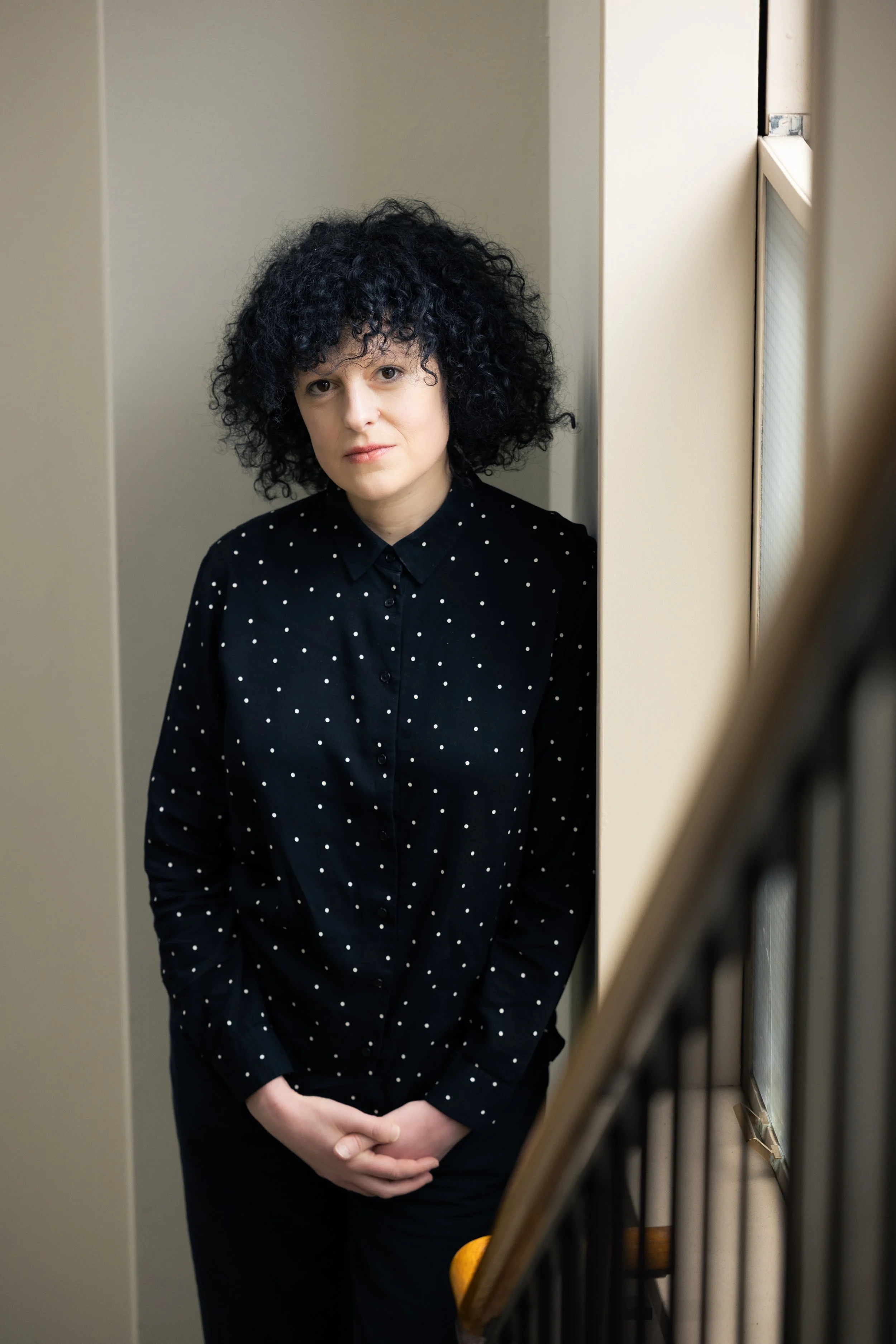
Polly Barton by Shinchosha
The main character works as a translator, and there’s a section where she talks about the earnestness of navigating a new language. You write about “desperately trying to make yourself understood,” of speaking from a place of vulnerability, which reminds me of the experience of love: expressing your feelings and hoping that they will be seen or reciprocated. I wonder how your translation work shaped your approach to writing romance in particular?
Yes, to the vulnerability of it: And then there’s this question that I’ve been mulling over a lot, namely to what extent the triad of central concerns in the book—translation, karaoke, and obsession—can really be said to be the real deal. I think with all of those, there’s space for someone to come in and say, ‘Look, this isn’t real! This isn’t mutual! This connection you’re feeling, this intimacy, this expression, is really just a semblance of something else, a poor imitation. An excuse for not being able to do the real thing.’ Various therapists on Instagram tell me that limerence is bad, and comes from trauma and uncertainty, and I don’t dispute that. It’s not the true vulnerability of real love, for sure. But all of these things—karaoke, translation, and limerence—do involve some semblance of communing with the universe, with the other. Maybe those relationships are the most romantic precisely because there’s the most room for delusion there. A lot of romance isn’t very sane, or healthy, and there are aspects of it that are overtly dangerous, but that’s where the fascination lies. That interplay between delusion and the real bits.
What Am I? interrogates the things we aspire to romantically, especially our programming towards a heteronormative ideal. As you wrote away from that idea, did it change some sense of what you wanted for your protagonist?
This is such a nice question. Here’s a cliché for you: When I started writing this book I didn’t know how it was going to end. By which I mean, I knew that the main narrative arc—the heterenormarc—was going to end in disillusionment. But I knew both that I didn’t want that to be the end end, and also that I had no other ideas of what the end could be. I don’t want to be too spoiler-y here, but I feel like the book ends by triumphing friendship—not perfect, but good enough friendship—and that really was something that came to me after working through what came before. I think it had to come about that way.
I think the even more surprising thing to come out of it, though, was the sense of grace that develops in the protagonist towards herself for having these desires that she can’t always stand behind – the desire for the heteronormative fantasy that she knows is pure fantasy, primarily, which in the book is symbolised by John King. I wrote a bit that ended up being cut where the protagonist keeps encountering the name, like a kind of sign. She sees a van appear outside her window, with the business name John King printed on the top. At first she’s shocked, but she then starts smiling when she sees it. She waves and says, ‘Hello, John’. I suppose it’s really a kind of self-compassion, but I like that it manifests superficially as a benevolence towards John. It’s a compassion that includes them both.
I try to avoid questions of genre, but thinking about this as your debut novel – I wonder if, as you’ve started promo for this book, questions have been posed to you as if you are the main character? How do you think about that collapse, and also, how are you approaching this book publicly as a work separate from yourself, in some ways for the first time?
This is fascinating to me because I think that I’m pretty bored by genre generally – or maybe a better way to put that is that the writing that I’m drawn most to sits intractably on the borderline of different genres, and particularly that between fiction and non-fiction/memoir. So this time, it’s amazing to encounter both the fascination around the shared traits I have with the narrator, and also this excitement that seems to accrue to The Novel! and maybe even especially The! Debut! Novel! I think something that writing this taught me is that the novel is really more about form than it is content. I discovered in writing it that there is—or can be—a huge formal freedom in it. And then another freedom in the fact that it’s separate from me.
Polly Barton is a writer and Japanese literary translator. Her translations include Butter by Asako Yuzuki, Hunchback by Saou Ichikawa, Where the Wild Ladies Are by Aoko Matsuda, and There’s No Such Thing as an Easy Job by Kikuko Tsumura. She has published two works of non-fiction, Fifty Sounds, for which she won the 2019 Fitzcarraldo Editions Essay Prize, and Porn: An Oral History. What Am I, A Deer? is her debut novel.
Noah T. Britton is a writer from the US based in Barcelona, Spain. He is the editor at Apartamento magazine.
