WORMS 10 in Colour: Melissa Febos
Beauty, beauty, beauty! Melissa Febos on new definitions of love and sex
In conversation with Caitlin McLoughlin, Melissa Febos turns her gaze inward, unravelling sex, love, and the radical possibilities of celibacy.
Interview by Caitlin McLoughlin
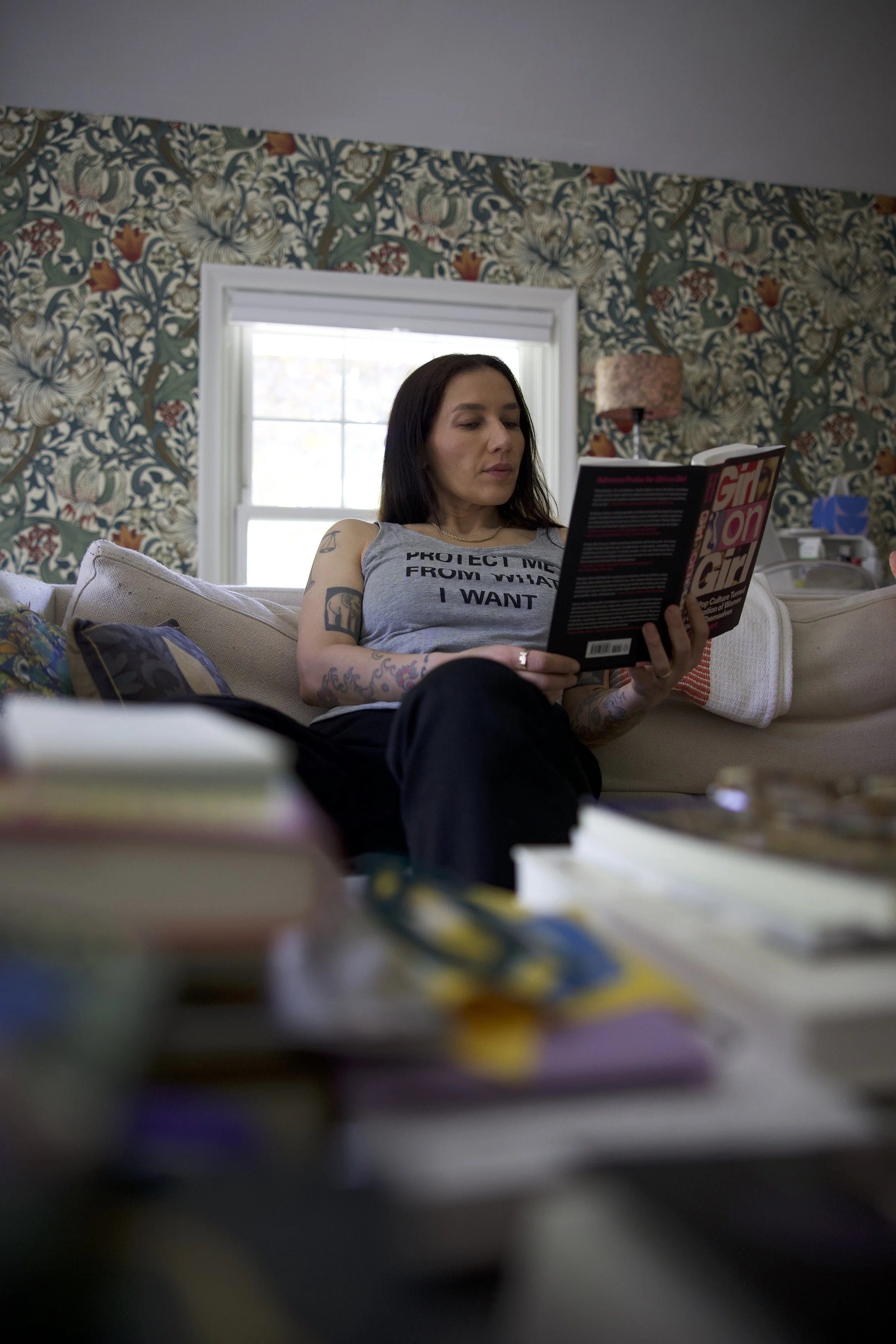
Photos by Karla Monroe
I call Melissa Febos on one of the first days that a drizzly London spring breaks open into something lush and green. Something like summer. I’m reminded of a moment she describes in her latest book The Dry Season: A Memoir of Pleasure in a Year Without Sex: “I walked across Brooklyn, past crowded stoops and sidewalk cafés and heavy-headed flowers in garden plots—fat peonies and blue hydrangeas—I smelled the blooming green on summer mixed with city-musk. In some moments every bit of life seemed to prove the existence of God.” Since reading her book, I’ve been seeing and feeling the world anew – savouring solitude, luxuriating in the shifting light at the end of the day, in the bright, tart sweetness of a raspberry.
It’s a book about celibacy that quickly reveals itself to be about far more: the reclamation of love, the politics of desire, the spiritual labour of choosing clarity over comfort. As we talk, the mood drifts between solemnity and laughter, our exchange held open by Febos’ insistence on emotional rigour without austerity. What unfolds is a conversation about mystic nuns and modern ambition, and the intimate choreographies of healing. Pulsing at its centre is a quiet proposition: that true love—whether for self, other, or art—begins with integrity, and grows through discipline.
The following is an extract from the full feature interview in Worms 10: The Love Issue. If you would like to read the full interview, consider becoming a member at the link below or purchasing your very own copy.
Caitlin McLoughlin: I love the way your books play with time, it feels layered and almost cyclical in a way that respects the complexity or non-linearity of memory. The Dry Season focuses on a year of your life that, towards the end of the book, you identify as eight years ago. How much of the writing in the book is from the time in which it explores? How much was written from memory?
Melissa Febos: That's a great question. I was going to say that there's no writing in the book from that time, but that is not true because I kept a journal specific to that year. Not for the purpose of writing about it, though. I always feel a little self-conscious when I admit that I never think that I will write about something as it’s happening. It's like, Nope, really just got there as a person making bad decisions. I almost wish there was more of a mercenary impulse. I'm sure the thought occurred to me that I would write an essay about it though.
Journal keeping is just a part of how I live because I don't think very efficiently inside my head. My thoughts move in a spiral and are very repetitive, they don't get very deep. So it's really in writing that I get to my next best thought. I have to write in order to impose a linearity on my own thinking, so I can progress it. Journaling is always a part of me trying to think about something or have a new idea. It is also a way for me to keep track of what happened and what I thought at the time because—this is not great for a memoirist—but I don't have an organised memory. It's all in there, but it's not chronological. The only thing I remember with any kind of exactitude is what I ate. I always remember what I ate. [Laughter]
“I have to write in order to impose a linearity on my own thinking, so I can progress it.”
[Laughter] I feel that.
The rest of it is like a collage.
While I was writing Girlhood, my third book, I initially conceived of writing about my year of celibacy as an essay in that book. I saved it for last and when I started writing I had one of those experiences that I think people who are not writers imagine writing is always like, where I suddenly looked up and was like, Oh shit, I have 40 pages and I’ve barely scratched the surface. It was clearly not going to fit. It then took me about two or three years to circle back to it. I published Girlhood and then I wrote and published Body Work, but during that time I was reading about it more – expanding the research that I’d done during the period I was celibate and looking at it more broadly. There was actually a lot of writing that came out of that intermission. I had a giant document that I think was about 80 pages by the time I came back to it, where I plunked quotes and thoughts I'd had. It was pretty heady and mostly intellectual; a lot of research that ended up not even making its way into the book. When it came to writing the book, I knew I needed to actually tell the story of what happened.
One of the tricky parts of writing memoir is that insight comes from different temporal locations. In order to facilitate interesting storytelling, or to have it not be long, discursive and boring—which is how real insight comes to us—you have to distill it into a package that sits within a framework of a reasonable amount of time. So the scope of the book is ostensibly one year, but really it covers my whole life from when I was fourteen until that year, and then all of the eight years after it until I wrote the book. It took me that long to get to what, in the book, is contained within a single year.
Perhaps more so than sex, The Dry Season is a book about love. Was part of your celibacy journey doing the work of detangling love and sex?
Previous to this experience—and maybe previous to writing the book—I had thought of love and sex as a discrete category. I was someone who had desperately tried to have successful casual sex, and it just never worked. So I had reconciled myself to the fact that sex had to have what I called love involved too. I really did think of it as a category of relationship and experience that was different from other categories like friendship or spirituality or even art. I started that time thinking, Okay, I've gotten myself to a really disastrous bottom where, even though I've been in relationships my whole life and I've been in therapy my whole life, I’ve still had quite a failed experience of love. So I needed to take an inventory and figure out what the fuck was going on.
What that meant was following my behaviour back to my thinking so I could tease out what my definitions were – what does love and sex mean to me? What is the belief system that I am operating from, because I want to change my experience, so I need to change my behaviour, and in order to change my behaviour, I need to look at the beliefs from which that behaviour is stemming. I knew, because I had tried to raise my own consciousness in other areas of my life before, that this belief system was definitely going to include some beliefs that I didn't choose, that I had inherited or had conditioned into me without my awareness.
“The rhetoric around romance and love in our culture is one of a very capitalistic perspective. It doesn't look systemically at why we keep having the same kinds of bad relationships, why we are attracted to the people we're attracted to, why we're making the same kinds of choices over and over again.”
I had to interrogate and destroy this idea of ‘love and sex’ as discrete or separate from other kinds of love, and that it should be at the centre of my life; and then choose a new set of beliefs for myself. Though, it really felt more like a discovery than a selection. I wasn't designing, I was uncovering and then trying to align myself with what I had uncovered. Which was that love was this amorphous category that was in fact holistic and not discreet from any particular area of my life. It was spiritual, it was creative, it was intimate—in the emotional sense—it was corporeal, and all of my important intimate relationships fit into it. That romantic love was a subset within that much larger category of love, and therefore ought to be infused with all of the meaning and vitality of that larger category. Which is to say, romantic love should be something that was congruous with everything I believed and should support my own and the other person's flourishing. It should not be possessive or dependent or selfish. It should be a generous kind of reciprocity. Which is not what I'd been doing. There's been a lot of the sublime in that cosmic sense in my relationships, but much more in a very finite, obsessive, dyadic way.
I think sex fits into this because sex is once again something we consider to be discrete from any other parts of our lives. What I understand now, beginning in that year, is that sex is just a set of activities that can mean anything. I can do it in the spirit of emotional intimacy. I can seek connection through it. It can be playful, it can be angry, it can be empty, it can be harmful, it can be abusive. It is amoral. It does not have a moral assignment. It's just an infinite number of possible activities that we enact to express an infinite number of things. Even within my marriage, sex doesn't mean one thing. It can be funny, it can be weird. It can be super emotionally intimate. It can be a form of procrastination. It's just like any other activity or experience – we bring to it what we bring to it. My goal is not to mould it to conform to some objectified idea of what it should be or what it should mean, but to make a conscious choice about what I want it to mean in any particular moment.
“Writing and creativity was the first space that I carved out inside of my life where I felt like I could be true and authentic in ways that were dangerous in other spaces.”
I was struck by how much of the book is about spirituality. You speak about growing up with a father who had rejected his catholic upbringing, subsequently encouraging a mistrust and even a disdain of religion—and by extension spirituality—in you and your brother. Your first break from this mindset was through getting sober. In relation to what you were just saying about belief systems and discovery, when it came to finding spirituality, was there this moment of realisation or epiphany, or was it more of a conscious process of learning and unlearning? How difficult was it to overturn that ingrained belief?
It was pretty easy. Beliefs are funny. Sometimes they're just a little flag that we tack over the doorway of whatever we're doing and then ignore. Then sometimes—and I think we’re seeing this all over this country in a very obvious way right now—we're like, This is what I believe—though, what you actually do with people you’re interacting with is a direct contradiction to that.
When I was young my father said, not entirely wrongly, that religion was dangerous and that it was weaponised to hurt people – that it was a stupid, literal reading of an allegorical book. I was like, Yeah, okay. That's what I believe. I never really questioned it. But alongside my holding that belief, I was a very spiritual person, even as a child. I was into ritual and ceremony and experienced an intimate connection to nature and art, and to myself. I was very aware of my incontrovertible, ineffable connection to every single thing around me. That was just instinctive. It was only overt religious behaviour that I was like, No, I am not into that – people who go to church are dummies. Then when I got sober, very smart people who had had similar experiences to me said, No, you have to pray and you have to have a higher power.
I remember there was a kind of epiphany moment. I was reading some recovery literature and it said something like, You have faith in electricity, but do you know how that works? I was like, No, but I totally trust that the lights will come on. I rely upon it pretty heavily. So it felt pretty easy to set this other belief aside. It's not a binary thing. I don't have to belong to a religion and I don't have to wholesale reject or accept anything. I can just move through life following the same set of spiritual instincts that have guided me for as long as I can remember.
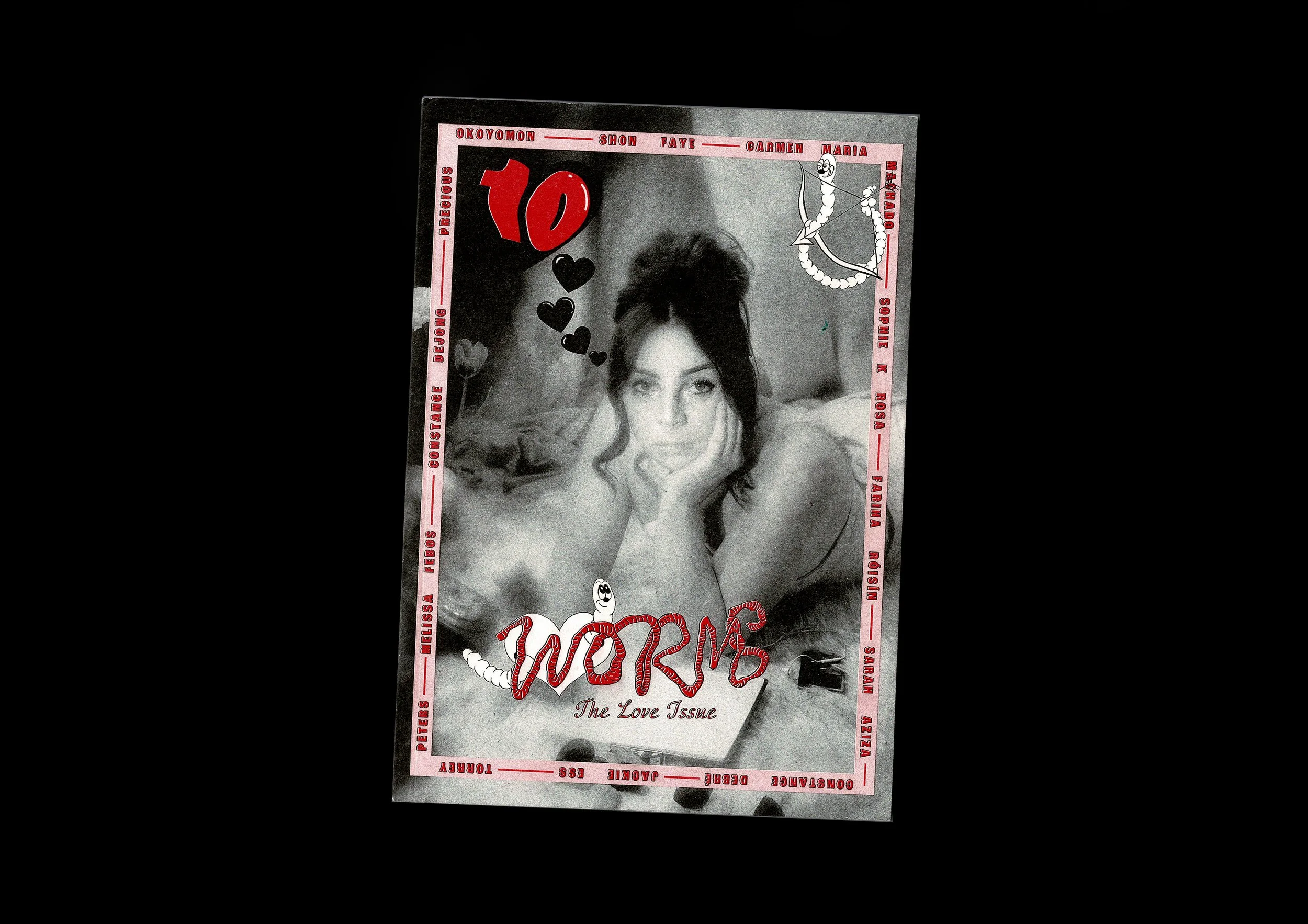
We’re SO excited to announce our return to print with Worms 10: The Love Issue, available now ♥️
This latest issue of Worms invites readers into a bold and tender exploration of love in all its messy, political, and transformative guises.
Set against the backdrop of state-sanctioned transphobia in the UK and US, ongoing genocide in Gaza, and a litany of global injustices that see us staggering under the weight of collective and personal upheaval, this issue reckons with thinking and writing about love in a time of crisis. How do we take seriously the seemingly frivolous demands of love, devotion, beauty—in all their myriad and sometimes painful forms—when basic needs and rights are stripped away.
Featuring voices from at home and overseas including Shon Faye, Torrey Peters, Melissa Febos, Constance DeJong, Sarah Aziza, Precious Okoyomon, Carmen Maria Machado and Constance Debré, as well as contributions from rising stars in experimental literature, we ask: How can we continue to love someone who refuses to change? Is writing about sex still strange – or have we done and seen it all? What do you do if you fall in love with your sperm donor?
From the resilience and fierce creativity of trans writers, the challenges and ethics of telling love stories that are not our own, to the guts and gristle of motherhood, pet love, age-gap relationships and getting off on poetry, Worms 10 is a testament to the power of writing, and of love, as acts of resistance, reclamation and truth.
FEATURING: Shon Faye, Jackie Ess, Precious Okoyomon, Constance Debré, Melissa Febos, Torrey Peters, Carmen Maria Machado, Sarah Aziza, Constance DeJong, Sophie K Rosa
CONTRIBUTORS: Caitlin Hall, Zara Joan Miller, Devki Panchmatia, Lu Rose Cunningham, Gabrielle Sicam, Aimée Ballinger, Mimi Howard, Enya Ettershank, Sufjan Bile, MK McGrath, Amie Corry, Dizzy Zaba, 2ly (Molly Cranston, Safiye Gray, Hanako Emden, Sophie Florian, Johanna Maierski), Jemima Skala, Fariha Róisín, Summer Moraes
PHOTOGRAPHERS: Minu, Dozie Kanu, Jen Dessinger, Karla Monroe, Sophie Williams, Ellen Stewart
ILLUSTRATORS: Rifke Sadleir, Chloe Sheppard, Charlotte Pelissier, Leomi Sadler
EDITORS: Caitlin McLoughlin, P. Eldridge, Clem MacLeod, Arcadia Molinas
DESIGN: Caitlin McLoughlin
Publication date: July 2025
Published in the UK by Worms World C.I.C.
Magazine | Paperback
240 × 170 mm | 184 pages
BECOME A FULL TIME WORM MEMBER…
Becoming a FERTILISER gives you full access to all of our digital content via the Wormhole, including extended reads on special features, exclusive newsletters, access to our archive, and reviews and recommendations from the Worms team. £3 per month OR Save 25% with an annual subscription for £27
