We Have Always Been Here
P. Eldridge interviews Mollie E. Barnes and Gemma Rolls-Bentley for their new book, Queer Art
Words by P. Eldridge
I'm midway through reorganising my bookshelf—queer theory wedged between feminist manifestos, dog-eared paperbacks threatening to spill onto the floor—when I first crack open Queer Art. It's the kind of book that stops you. Not just because of the images, which are arresting in the way only art made from genuine necessity can be, but because of the argument it quietly, confidently makes from its very first pages: that queer visual culture has always been here, threading itself through history whether history chose to acknowledge it or not.
Curated by Mollie E. Barnes and Gemma Rolls-Bentley, Queer Art is a commanding compendium spanning the 19th century to the present day; a book that refuses the reductive shorthand so often applied to LGBTQIA+ art, the tendency to measure queerness only against overt homoeroticism or documented homosexuality. Instead, it insists on something richer and more honest: the full complexity of lived experience, rendered across generations and geographies. Artists like Keith Haring, Catherine Opie, Hélio Oiticica, Bhupen Khakhar, Lotte Laserstein, Danielle Brathwaite-Shirley, and Xiyadie populate its thematic chapters—on liberation, intersectionality, reclamation, and futurism—not as curiosities or symbols, but as practitioners whose work actively shapes the world it reflects.
I spoke with Barnes and Rolls-Bentley about the tension between categorisation and queerness, what it demands to look at non-Western art on its own terms, and why—in a moment of terrifying global rollbacks on trans rights—sending a book of queer futures into the world feels less like a statement and more like an act of survival.
“We knew early on that attempting to write a definitive encyclopaedia of queer art is an impossible and, frankly, un-queer task.”
P. Eldridge The book opens by arguing that queer art is not a genre but a gesture; a refusal to be pinned down. That's a bold starting position for a book that is, by its nature, doing the work of categorisation. How did you both negotiate that tension from the very beginning, and did it change how you thought about what the book could and couldn't be?
Gemma Rolls-Bentley I’ve spent a lot of my career thinking about the parameters of what “queer art” actually means. For me, it is much less about drawing a strict boundary around a genre and more about offering a specific lens. Mollie and I leaned right into that tension from the start. We knew early on that attempting to write a definitive encyclopaedia of queer art is an impossible and, frankly, un-queer task. Recognising that a physical book is inherently a container actually liberated us. It changed the project from trying to be the final word into being a provocation. Applying a queer lens introduces entirely new ways for audiences to access a work and allows us to reconsider the context in which it was made. Rather than locking artists into a rigid category, this book is meant to offer a vantage point.
Mollie E. Barnes In this book's structure, we are rejecting categorisation in one sense and embracing it in another. We necessarily categorise these artists and artworks as ‘queer’ by their inclusion. Any categorisation is unstable (and we all wish unneeded) – but it provides a structure to gather the necessary and overlooked stories, lineages, and practices, while acknowledging that these frameworks are provisional. We have broadly rejected a categorisation by canon or media and instead focus on themes or meaningful essences for each artist and artwork’s inclusion, using chapters like ‘Love and Liberation’. I hope we have allowed the book to remain aligned with queer theories referenced—Judith Butler, José Esteban Muñoz—resisting essentialism and fixed identity categories. It’s not a book about defining queer art—as Gemma says, that would be very un-queer—but it traces how queer art has always operated across time and space. We accepted that this book or any book would never be exhaustive or definitively representative. It’s curated, bringing together artists who resonate across time and geography to provide an introduction.
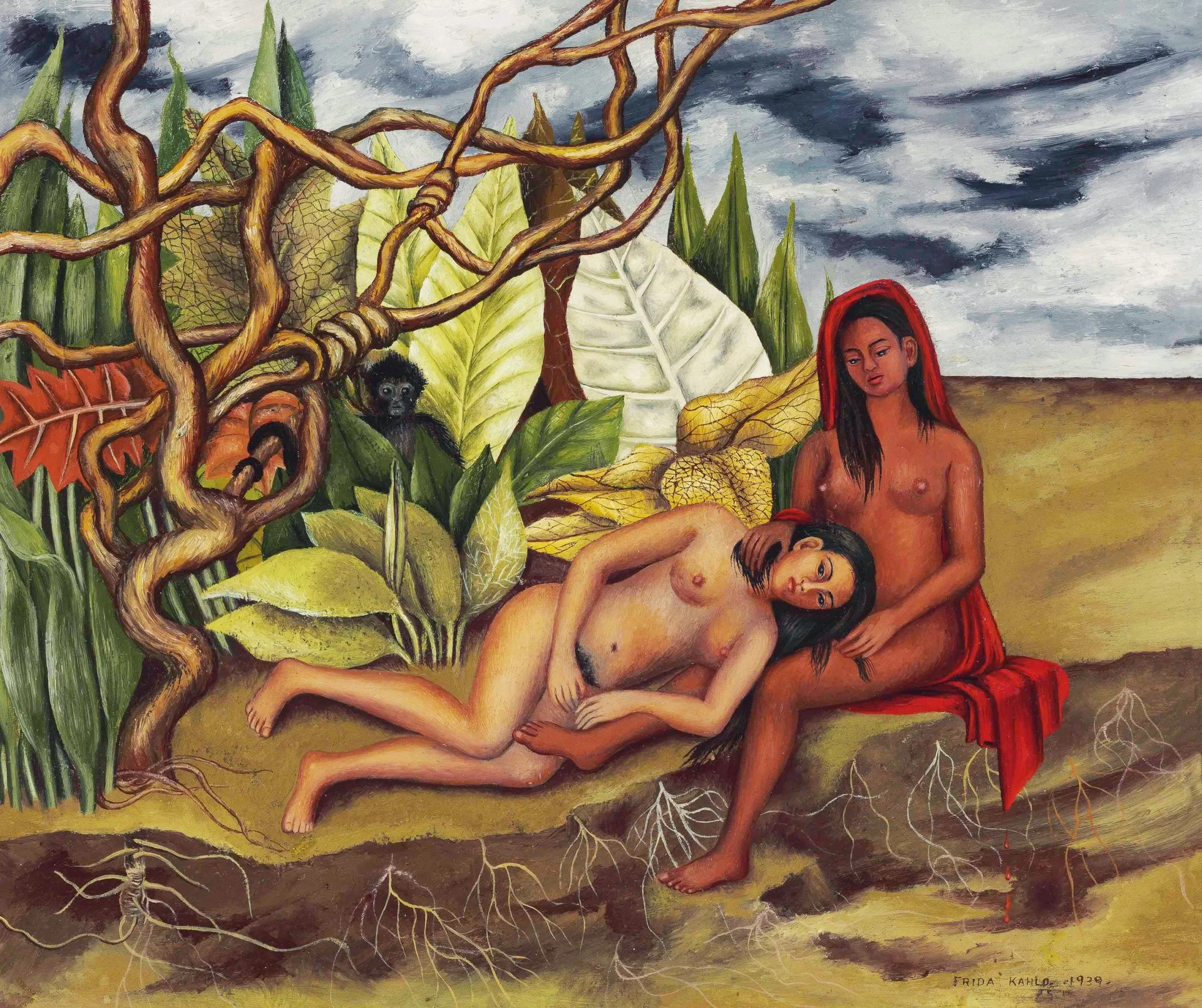
Frida Kahlo, Dos desnudos en el bosque (La tierra misma) (Two Nudes in a Forest), 1939. Oil on metal, 25 x 30.2 cm (9 7/8 x 11 7/8 in.). Private Collection.
PE The four thematic chapters—Queer Selves, Resilient Histories, Love and Liberation, Queer Futures—feel both inevitable and quietly radical in their ordering. How did those frameworks emerge, and can you talk about the losses; the artists or works that didn't make it in, and what that editing process felt like when the subject matter is so politically and personally charged?
GRB These chapters are inherently fluid, which in itself feels somewhat queer as an approach to structuring a book. Many of the artists could easily sit across multiple chapters depending on how you frame the discussion about their work.
‘Queer Selves’ leaves a necessary, expansive space for multiplicity. It highlights how delving into deeply personal, lived experiences can offer vital points of identification and insight for the viewer. ‘Resilient Histories’ is an active homage to those who challenged norms just to survive. Many of these artists were punished for their queerness in their own time or completely erased. With the distance of time and new frameworks of knowledge we have a responsibility to uncover and re-examine those histories. ‘Love and Liberation’ moves beyond the expectation that queer art must be sexually explicit. For so many artists, queerness is fundamentally about the radical act of loving oneself, loving each other and building chosen families. ‘Queer Futures’ was the only way we could end the book. Artists possess the unique power to show us better alternative versions of the world. Ending on a note of hope felt vital.
As for the artists and works that didn't make it in, the editing process was naturally incredibly difficult. Ultimately we had to accept that this book could never include everyone. It is simply a snapshot, a single example of what is out there in a vast and expansive world of queer art.
MEB We spent a great deal of time selecting the 50 artist profiles in the book. The structure then emerged during that process. For example, ‘Queer Selves’, the first chapter, foregrounds identity and acknowledges a state of fluidity in queerness – informed by the many incredible queer thinkers before us, and those that are contemporary. ‘Resilient Histories’ acknowledges that queer lives are often entangled with archival absence, recovery and immense strength. There is a kind of chronology in the order of chapters of course: understanding the self, then the past, the present in ‘Love and Liberation’, and finally ‘Queer Futures’, which draws on a utopian, horizon-oriented mode of thinking. That last chapter is especially indebted to José Esteban Muñoz’s idea that queerness is almost always oriented toward what is not yet here. Assigning lives to chapters is iterative. Some artists fit comfortably in a chapter, but also have affinities throughout others. There is always some slippage, accepting that any profile inclusion could belong elsewhere. This instability is part of the book’s logic.
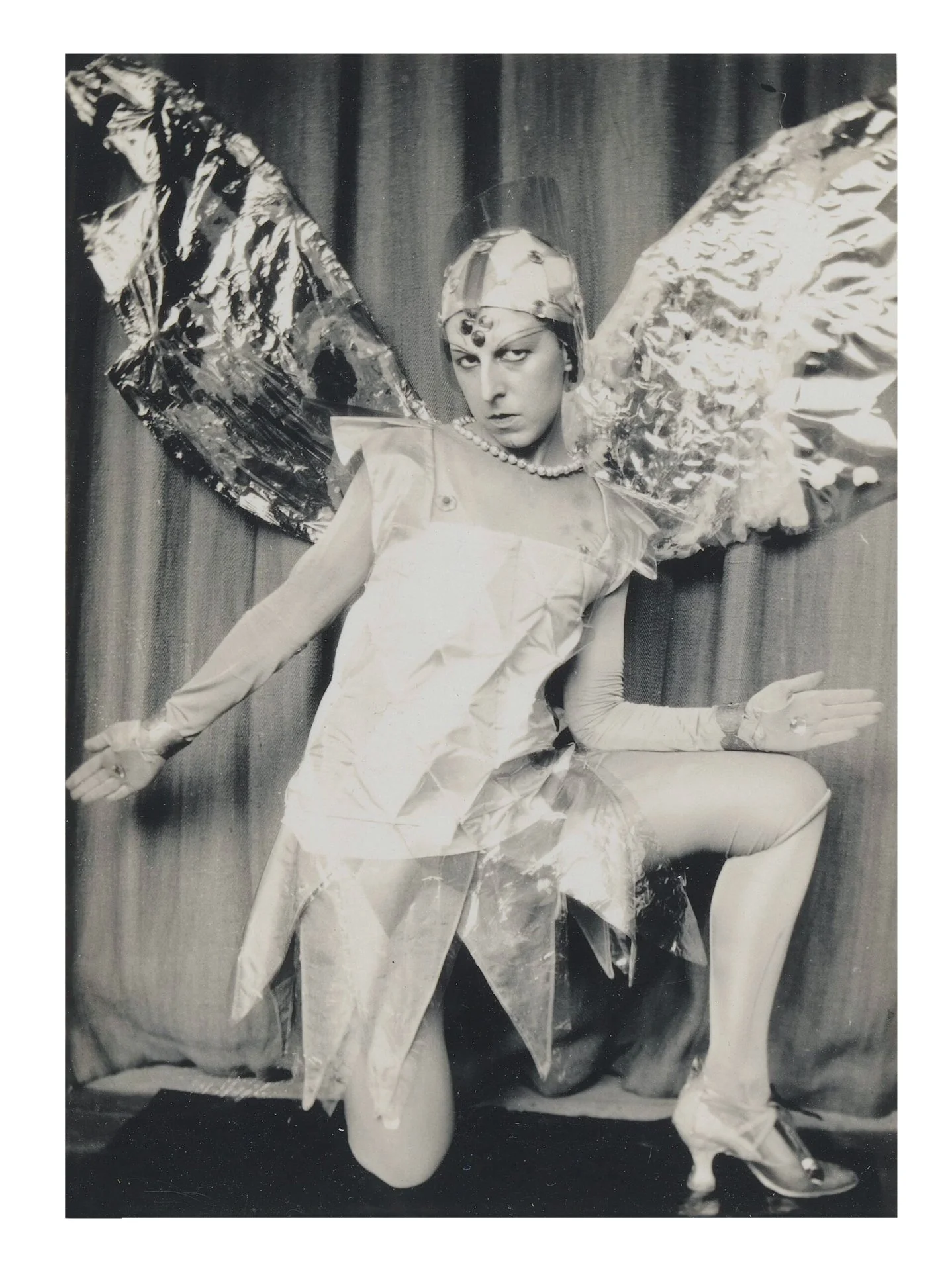
© The artists' estate. Claude Cahun and Marcel Moore Untitled (Claude Cahun in Le Mystère d’Adam), 1929. Gelatin silver print 10 × 7.6 cm (4 × 3 in.)
Any act of selection, especially in a field shaped by historical erasure and uneven visibility, carries ethical weight. These absences were felt by us both, and they only underscore the need for further projects, books, and other forms of scholarship and curation. I can’t wait to see and read them all.
“Curators are never neutral.
No one is.”
PE Claude Cahun's 1929 photograph Untitled (Claude Cahun in Le Mystère d'Adam)—costumed in metallic wings, merging the angelic, the androgynous and the futuristic—is one of the most prolific images in this collection (to me). Cahun described themselves as having many masks, and yet these photographs were never intended for public viewing. There's something almost paradoxical about reproducing them in a widely distributed book. How do you think about the ethics of bringing deeply private self-fashioning into public circulation, especially for artists who couldn't have anticipated it?
GRB We are presenting work by artists who could never have lived openly during their lifetimes, but whose work can now be celebrated by a contemporary audience that not only understands that difference but shares it. We address this ethical grey area directly in our introduction. It is always challenging when you cannot ask an artist how they wish to be contextualised. However, when you dive into their archives, their writings and their queer worldviews, it becomes clear that they were pushing against the boundaries of their time. Take Gluck for example, who radically declared “I have no prefix.” I truly believe so many of these artists would be blown away to see the world their work exists in today and to know they helped build it.
MEB This is a really interesting thought process that came up in a few instances in the research for this book. Each needed to be handled with care, as well as understanding of dynamics of power and consent. We worked to select the image that felt most appropriate. In this example, Cahun’s self-fashioning images were not entirely private. Images like What Do You Want From Me? (1929)appeared on the cover of their book Aveux non avenus, and others in magazines. This image, Untitled (Claude Cahun in Le Mystère d'Adam), felt appropriate for our inclusion. Cahun was performing in plays such as Le Mystère d’Adam in Paris in the late 1920s as part of an experimental theatre group. It brings together some key concerns that run through their work: theatre and androgyny alongside fascinating ideas of artifice and transformation. Importantly, it also exists in dialogue with other images produced at the same time, some of which were reworked by Cahun into montages as part of their own published book Disavowed Confessions (1930). What has definitely shifted is context. These photographs have now been widely exhibited, including at the National Portrait Gallery, which reframes them. The photographs we see today were not originally conceived as autonomous artworks but as part of broader projects. As Gemma says, it’s impossible when you cannot ask the artist themselves. With their new context and popularity – withholding these images would risk diminishing their new art-historical and political significance and their ability to speak across time to ongoing questions of gender fluidity, embodiment, and self-construction. At the same time, it was essential to approach them with care. We saw this as shifting emphasis from exposure to contextualising the work and foregrounding the complexity of Cahun’s practice.
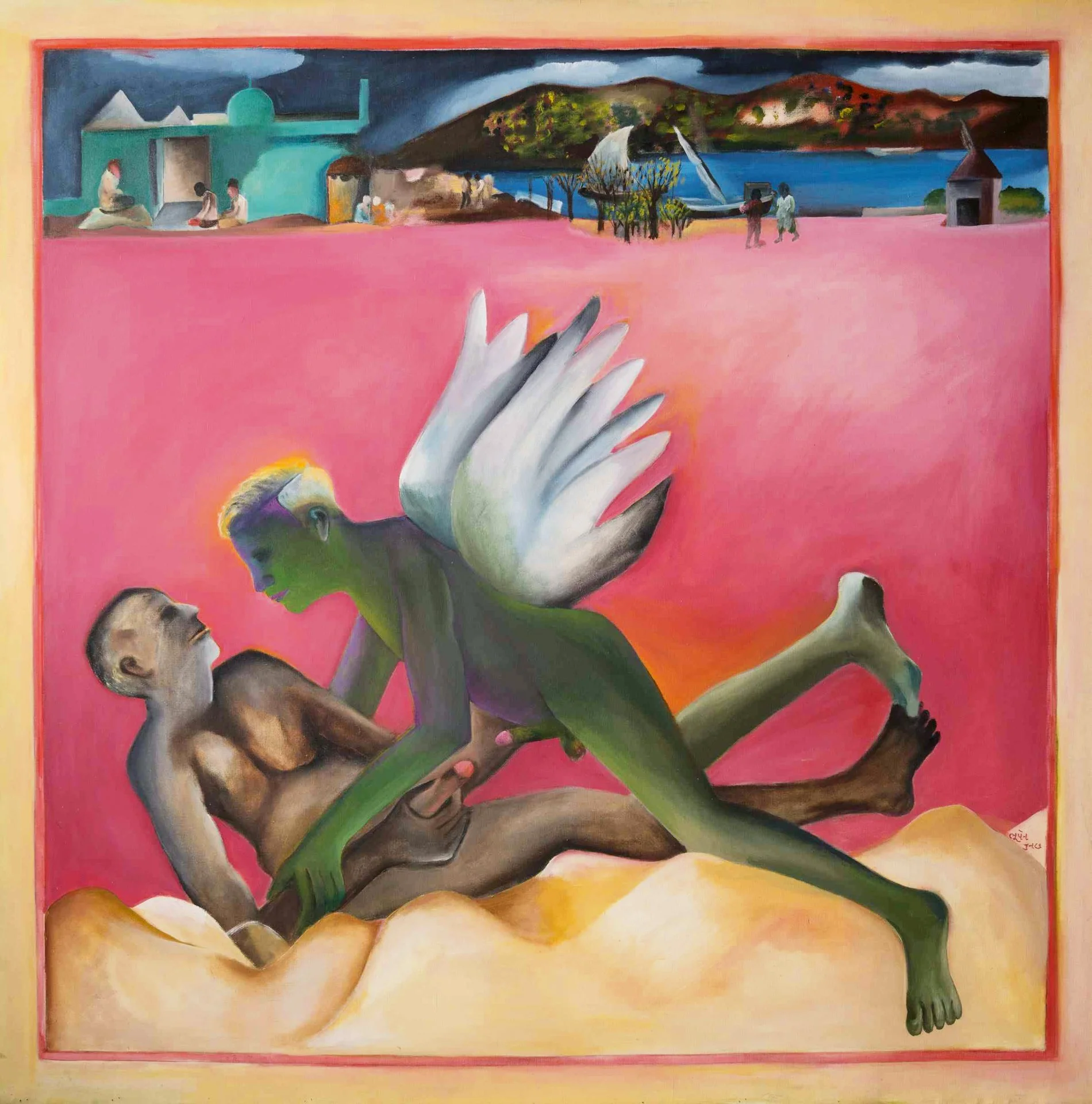
Courtesy Chemould Prescott Road. © Estate of Bhupen Khakhar. Bhupen Khakhar, Yayati, 1987. Oil on canvas, 91 x 122 cm (35 7/8 x 48 1/8 in.). Private Collection.
PE Yayati (1987) is a startling work; same-sex tenderness encoded inside an ancient Hindu myth at a time when gay rights activism in India hadn't yet taken shape. The book situates Bhupen Khakhar as a pioneer of gay visibility precisely because of the cultural specificity of his approach. As a curator working across geographies, how do you resist the tendency to read non-Western queer art through a Western framework, and what does it demand of you personally to hold that complexity?
GRB This requires constant, active unlearning. Queer art history has historically been written through an overwhelmingly Western, cisgender and white lens. When I was doing my art history degrees in the 2000s it became glaringly obvious how geographically restricted that teaching was.
As a curator, resisting that tendency means putting in the work to understand an artist's highly specific cultural circumstances rather than projecting Western milestones onto them. With someone like Khakhar you have to read the codes of his own environment. It is challenging, especially because many artists in non-Western regions still cannot speak openly about their queerness due to systemic danger. Ultimately it means engaging with the work on its own terms and respecting the artist's reality rather than expecting Western-style visibility.
MEB We absolutely need to acknowledge that we are conduits of where we grew up – what we have learnt and who we are. Curators are never neutral. No one is. We are all shaped by contexts, but that awareness of context and personal bias is a critical tool to question things – and to remind ourselves to keep questioning too. Never get too comfortable, or stop learning. What frameworks exist? How are we looking at this? Whose narratives have been centred and whose have been marginalised or misunderstood? What are we looking at? How are we inadvertently translating it into familiar, often Euro-American languages or ways of seeing? As Gemma says: this needs unlearning too, which is a continual process for everyone.
In a practical sense, I really think this needs discussion and sharing. I was so pleased to do this project in a duo – nothing can be achieved or understood alone. Not only with the two of us, but with our networks of artists that we were in constant discussion with, or the amazing team at Thames & Hudson (including Mohara and Lue!) and our wonderful editor, Fern. Collaboration, community and shared thoughts and processes only lead to better understanding.
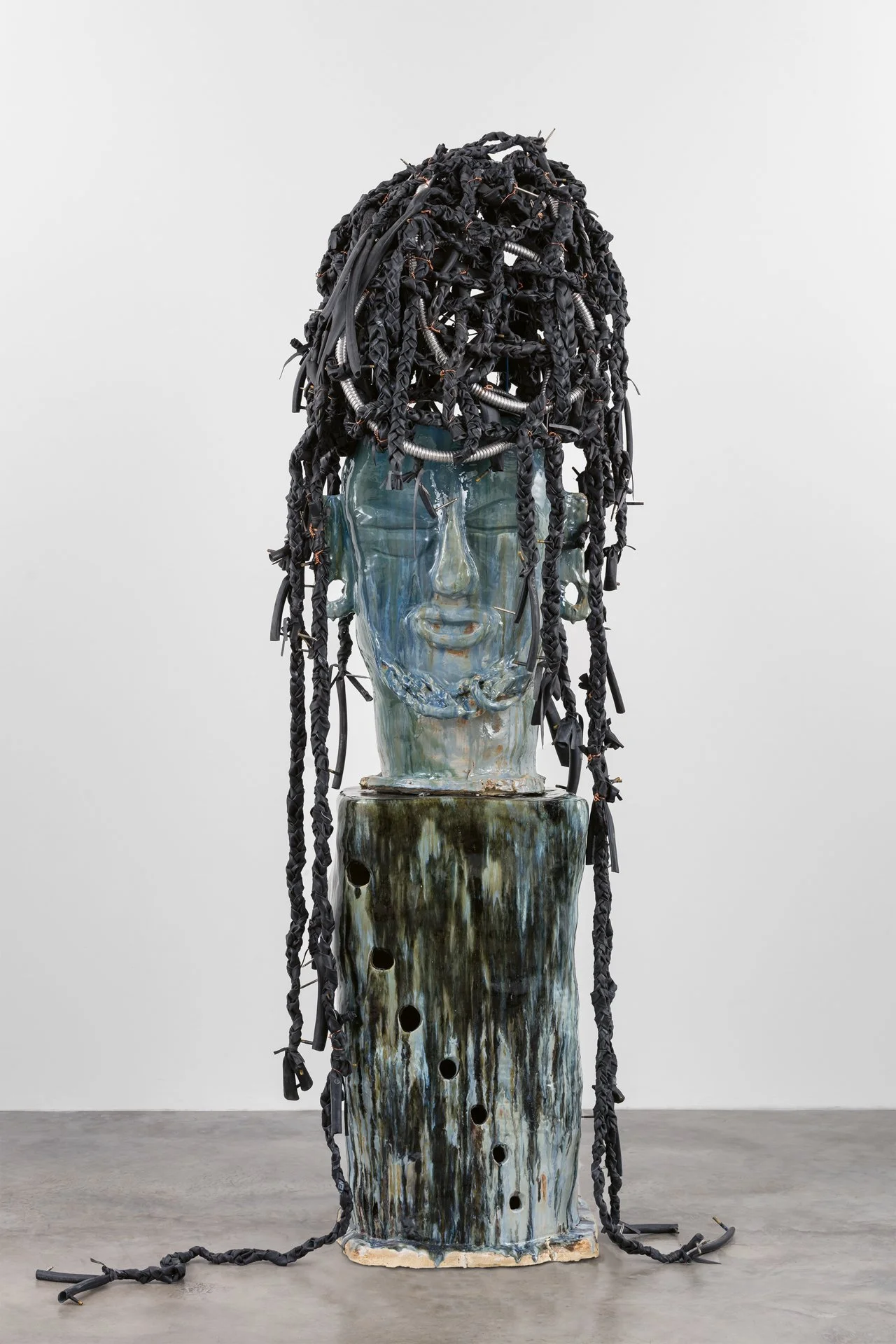
Courtesy the Artist; Stephen Friedman Gallery, London and New York, Gordon Robichaux, New York and Galerie Max Hetzler, Berlin | Paris | London | Marfa. Photo Todd-White Art Photography. © Leilah Babirye Leilah Babirye, Namasole Wannyana, Mother of King Kimera from the Kuchu Royal Family of Buganda, 2021. Ceramic, wire, metal electrical conduit, bicycle tyre inner tubes and found objects. Overall dimensions (in two parts): 273 x 84 x 84 cm (107 1/2 x 33 1/8 x 33 1/8 in.)
“Many queer artworks are sadly inseparable from real and ongoing risk. Risk introduces a different order of responsibility for curators, writers and galleries, shifting responsibility from interpreting a work to carefully mediating its visibility and its conditions. There is an ethical obligation to ensure visibility does not become exposure the artist cannot control, especially when stakes extend beyond institutions into real life.”
PE Leilah Babirye fled Uganda in 2015 after being publicly outed, and continues making work that directly confronts Uganda's Anti-Homosexuality Act. Her sculpture Namasole Wannyana—built from discarded materials, named for a Buganda princess, part of an imagined queer royal lineage—is extraordinary in its ambition. When you're curating work by artists for whom visibility carries genuine physical risk, how does that weight sit with you, and does it change what you owe those artists in how you write and present their work?
GRB It comes down to a foundation of ongoing dialogue and consent. Leilah is a brilliant example of an artist who operates with immense public courage. She lives in the US where she was granted asylum and she is fiercely committed to tying her art directly to her activism. However for artists where visibility equates to immediate physical danger the curatorial responsibility shifts entirely. There are artists I work with where we must be far more guarded. Their perspectives are invaluable but presenting their work requires careful protective consideration.
MEB Many queer artworks are sadly inseparable from real and ongoing risk. Risk introduces a different order of responsibility for curators, writers and galleries, shifting responsibility from interpreting a work to carefully mediating its visibility and its conditions. There is an ethical obligation to ensure visibility does not become exposure the artist cannot control, especially when stakes extend beyond institutions into real life. This includes working with the artist and their gallery or representative on context and presentation. Writing about or exhibiting such work means participating in its circulation and the conditions that make it visible. This awareness does not necessarily lead to restraint or withholding a work, but to a more deliberate engagement. It is important to foreground the artist’s wishes.
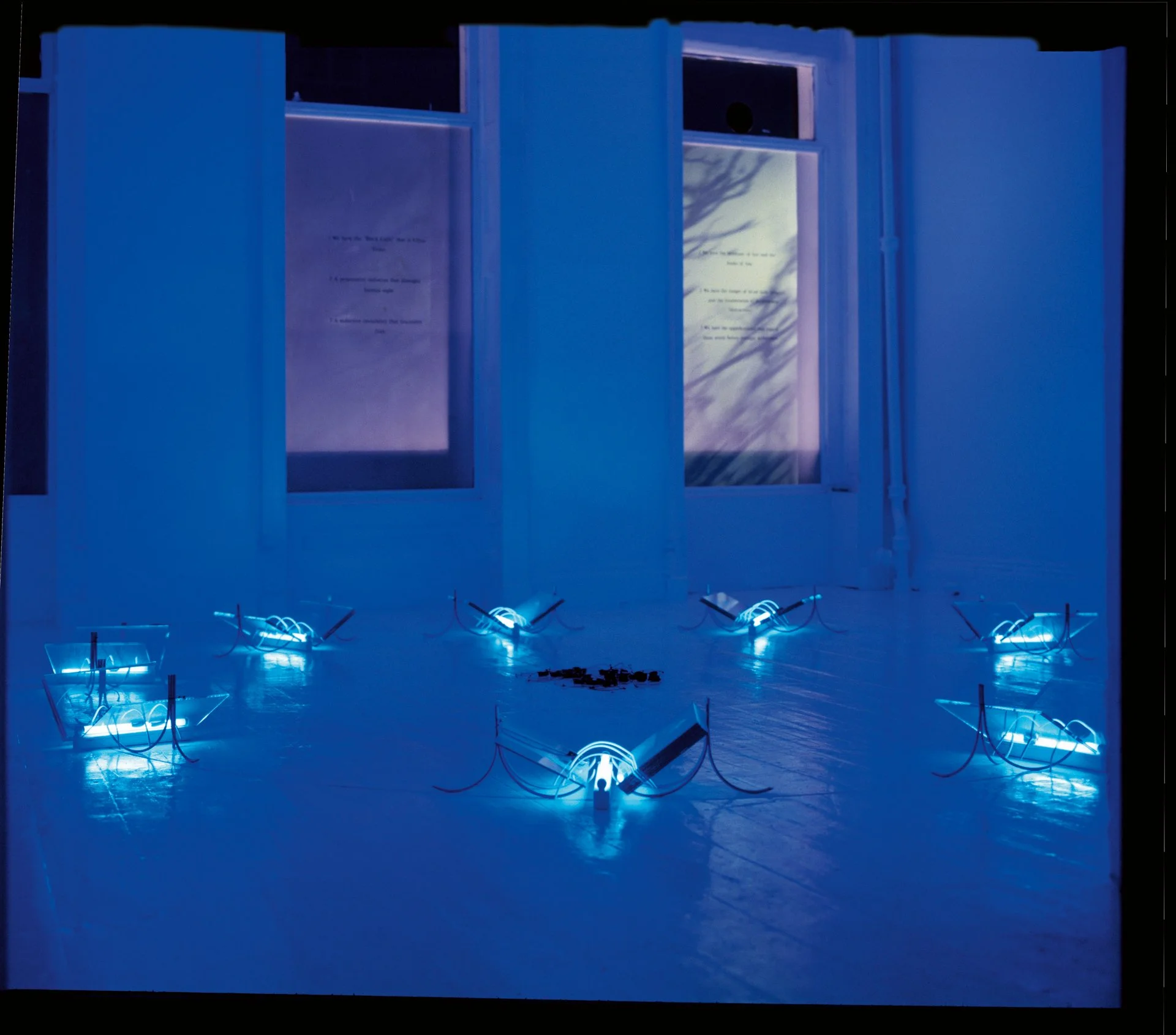
Courtesy Jamal Butt. Hamad Butt, Transmission, 1990. Etched glass, steel, rubber tubing, wires, bulbs and ultraviolet light. Dimensions variable (up to 4 metres, 13 feet in diameter). Installation view, Goldsmiths College, London, 1990. Tate Collection.
PE Transmission (1990)—nine glowing glass books etched with triffids, ultraviolet light you cannot safely look at directly—feels almost unbearably prescient. Hamad Butt died four years after graduating, at thirty-one. The book places this work in the Queer Futures chapter, not the past. Can you talk about the deliberate decision to frame AIDS-era work as futurity rather than history, and what you think is lost when the crisis gets archived as something that happened rather than something that continues to shape queer life and art?
GRB When we look at AIDS-era work there is a tendency to archive it purely as tragedy or history. But Butt wasn't just reflecting on the past. He was actively reaching for a future while living through the absolute terror of the present. By referencing futuristic culture like The Day of the Triffids and utilising ultraviolet technology he was exploring lifecycles, endurance and what comes next. Placing his work in Queer Futures reflects our decision to focus on what artists like him were actually concerned with at the time.
MEB It was really a refusal of closure. Repositioning this work in ‘Queer Futures’ places the work as active politically. Butt’s work was future-oriented. It felt wrong to place it in the past. More broadly, AIDS-era work, we believe, is something that continues to inform how queer futures are imagined, constrained, and fought for. The ongoing realities of HIV (medical, social, and geopolitical) risk being obscured in Western contexts where treatment advances have created a narrative of resolution. Archiving a crisis risks losing critical awareness. Queer futures are still negotiated in relation to history.
“If this book does nothing else I hope it proves that we have always been here. Trans and queer perspectives have always existed and they have always had so much to teach us. Where language often fails us in politics, visual art steps in.”
PE The introduction makes a point of saying the book doesn't intend to define queer art but rather to trace motifs through it; and that artists' estates had to approve reproduction, meaning there's an element of self-identification built into the structure. But curation is never neutral. As a queer woman, what are the specific responsibilities that come with being a queer curator, writing and working in a field that has historically been dominated by white cisgender male perspectives?
GRB The word curator comes from the Latin curare meaning to care. That etymology is the absolute anchor of my practice. As a queer woman navigating the art world my main focus is finding and creating opportunities for brilliant artists who might not easily fit into traditional art world spaces as well as applying a queer lens to the work of established figures who have profoundly influenced our culture. Ultimately I just feel incredibly lucky to build a career around art that inspires me and to work alongside artists who are actively driving cultural change.
MEB There are huge responsibilities, including identifying artists in the past and present - particularly those who have been excluded or forgotten, which means working with incomplete or biased archives, and the current structure of the canon. It is also rethinking structures that works and artists are presented - as we have tried to do in our chapter structures. Understanding intersections including race, class and disability. Question language that we all use - this links to our section in the introduction on the word ‘queer’ itself!
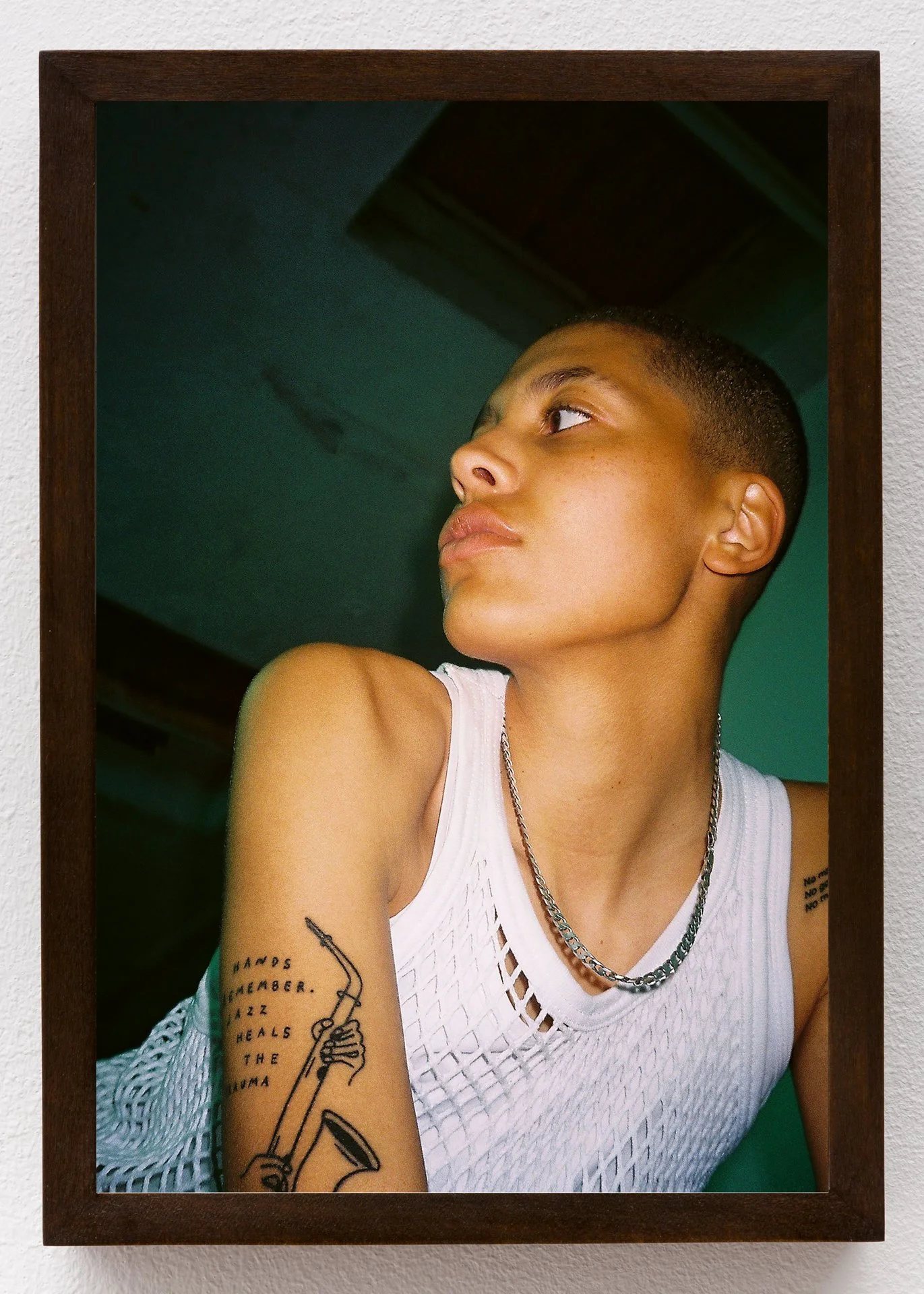
Courtesy the Artist and Arcadia Missa, London. © Rene Matić. Rene Matić, Kai in White, 2019. Inkjet print, framed; unframed dimensions: 25 × 16.9 cm (97/8 × 65/8 in.)
PE Rene Matić's photograph Kai in White (2019)—intimate, tender, shot on the simplest of terms—sits in the Queer Futures chapter alongside digital archives and speculative installations. It's quietly radical precisely because it refuses spectacle. Looking at the youngest artists in this book, what do you think the next generation of queer art is reaching toward, and given the political rollbacks around trans rights happening globally right now as this book publishes in April 2026, how do you feel about sending it into the world at this particular moment?
GRB Releasing this book right now amidst terrifying global rollbacks on trans rights feels urgent. If this book does nothing else I hope it proves that we have always been here. Trans and queer perspectives have always existed and they have always had so much to teach us. Where language often fails us in politics, visual art steps in. Artists like Rene Matić and Danielle Brathwaite-Shirley are literally inventing new languages and utilising new mediums to communicate the lived realities of their communities. We also see this in the work of incredibly fresh voices like Salman Toor and Ad Minoliti who are quietly but radically shifting the demographics of who gets to be the subject of a masterpiece. They refuse spectacle yet they are engaging massive audiences. People are listening to them and that gives me hope for what comes next.
MEB I hope this book inspires further books. A thousand more to add to everything else already done and being done – each shouting about these incredible artists and voices, and refusing to entertain the idea that queer voices haven’t always existed. The present is scary. There are so many questions and threats to LGBTQIA+ futures, including the violent attacks on trans rights. Many works in this book and beyond are produced within similar contexts of precarity and violence. I think this book is an act of hope and community.
You can learn more about the book here. A very special thanks to the team at Thames & Hudson. See and read more about Mollie and Gemma below, and follow their impressive work at their socials:
Mollie E. Barnes is a curator, researcher and writer focused on equitable access and representation in the arts, working across contemporary visual culture. She is currently the Visual Arts Curator at Salisbury Cathedral. @mollieebarnes
Gemma Rolls-Bentley is a writer and curator. She has curated internationally, including at ICA London, the Alice Austen House, New York, and the LeslieLohman Museum of Art, New York. She has taught at the Royal College of Art and Central Saint Martins, London. @gemmarollsbentley
P. Eldridge—curator, writer, and cultural worker—is the founding editor of SISSY ANARCHY. A 2025 Amnesty International Artist-in-Residence and collaborator, her practice spans the 60th Venice Biennale, the "SISSY" column for Gay Times, and the directorship of Worms World C.I.C. She lives between London and Australia; her first book is forthcoming with Montez Press. @pierceeldridge
