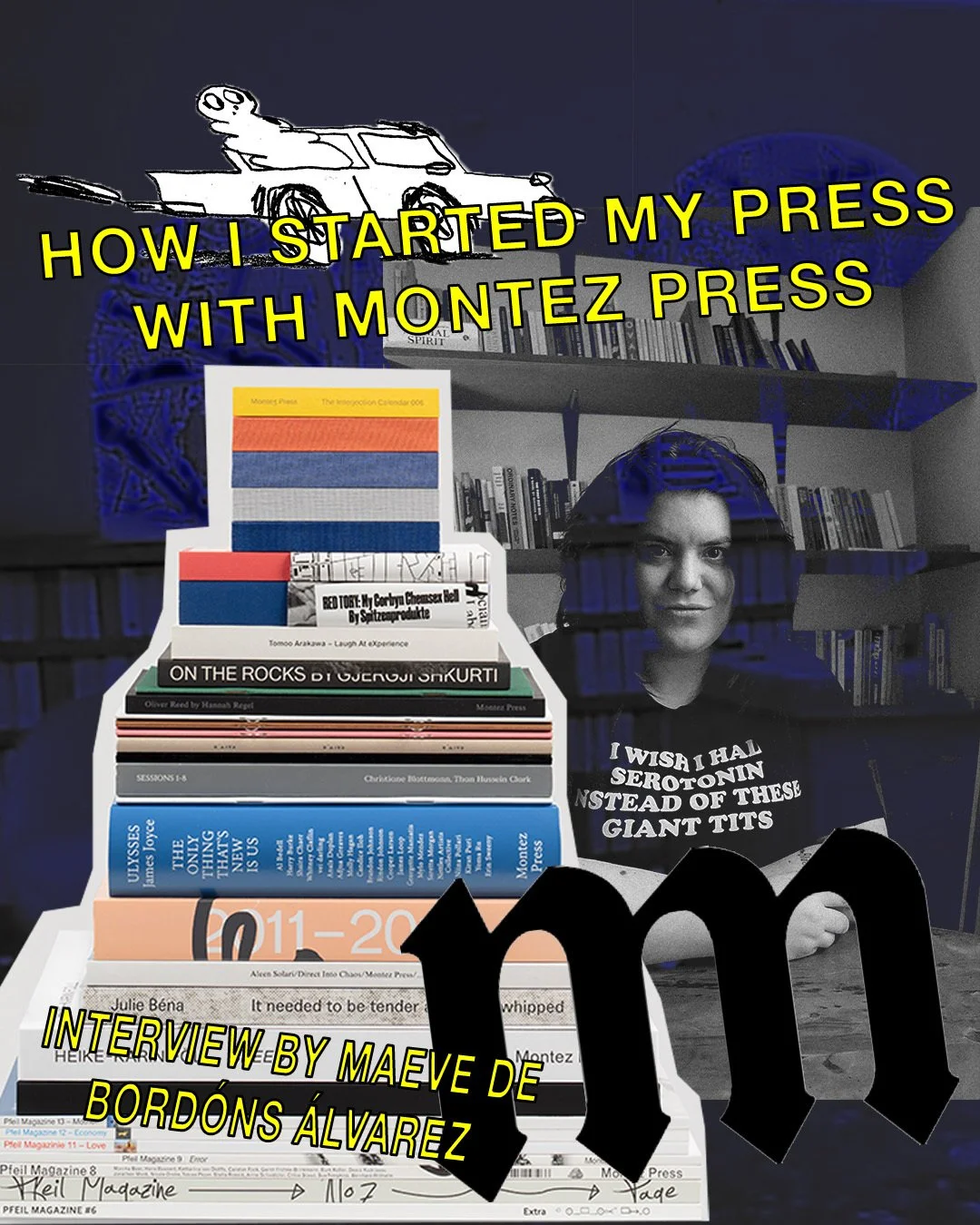
Montez Press is an artist and writer lead publisher started in 2012 between London and Hamburg by a collective of friends who met on a student exchange between Goldsmiths University and Hamburg School of Art. Than Hussein Clark, Will Joys, Christiane Blattmann and Anja Dietmann started a publisher that challenged artistic publishing at the time; creating a space for fiction, queerness and cross disciplinary endeavours. Since then, Montez Press has evolved, currently bringing out four book commissions and two periodicals annually. The team at Montez Press are in a constant dialogue between their network of organisations, which also include Montez Press Radio (based in New York), London Performance Studios, and The Writers Theatre Directors Theatre, leading to anthropomous cross-programming across them.
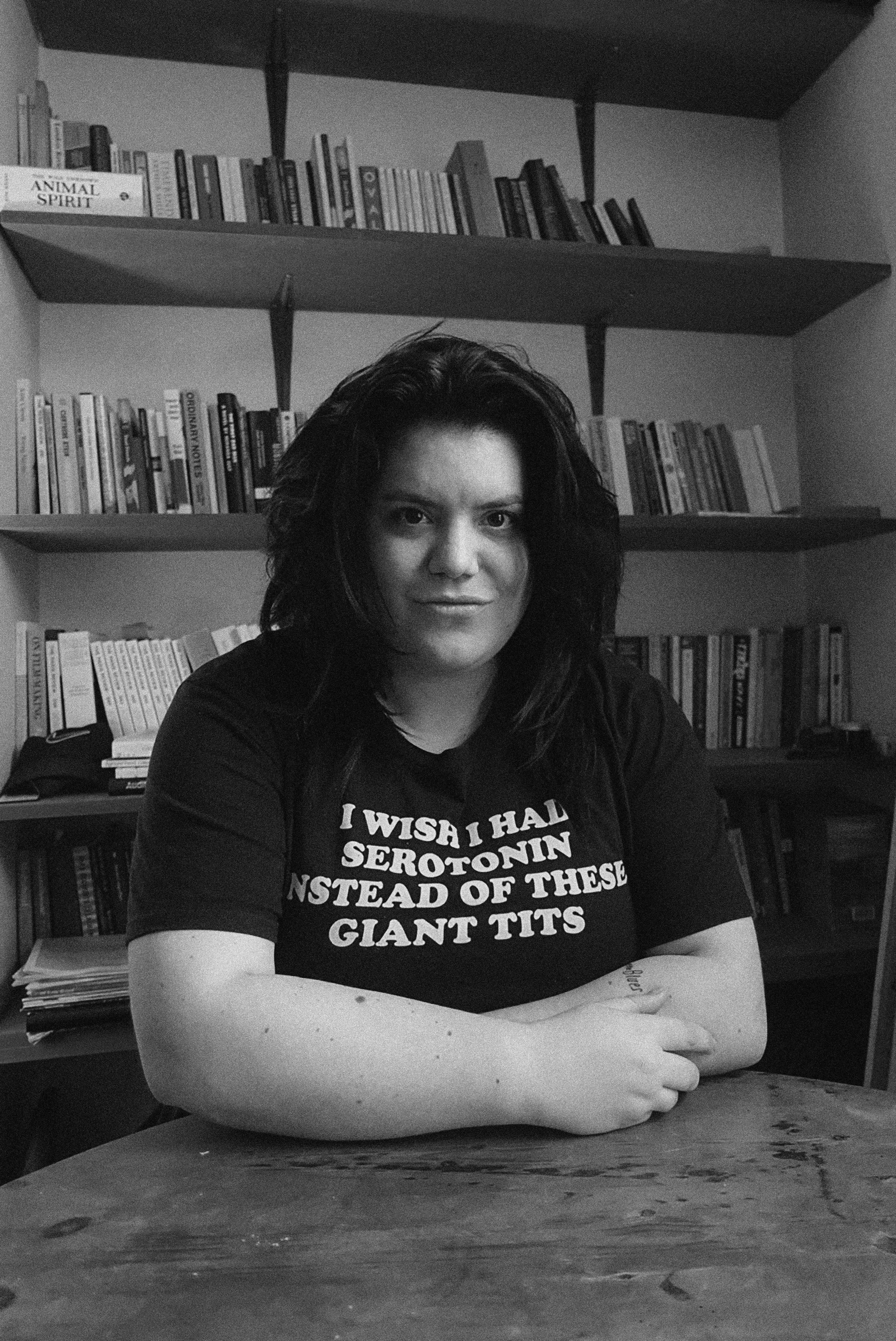
For over a decade, Emily Pope has been involved with Montez Press, of which she is now Director. At the time of its inception, Emily was Than’s studio manager, and initially got involved that way. She then did a master’s in writing and came on as an assistant editor in 2012 when Montez was really just getting going. She loved the work, and the ethos of Montez Press, which had many crossovers with her own artistic practice. Currently, she works very closely with one of their founding members, Anna Clark, to keep things running.
Her universe is informed by speculative explorations of contemporary broadcast media, feminism, class, and political rhetoric. All of this is reflected in her works as a visual artist, writer and broadcaster. Emily’s interest in autobiography infuses her curatorial choices, particularly in the projects that she and the Montez team take on. “I’m interested in the eccentricities of people, and how those translate through text and art,” Emily says. In her role as Director, tenacity and boldness are key when approaching projects she believes in. Whether she is working on projects for Montez, teaching, leading an artist workshop, filming or writing, what's clear is that Montez Press is a living, breathing, press (and radio) that is as resilient and passionate as those working behind the scenes to bring each idea to fruition.
Maeve de Bordóns Álvarez: How have you seen Montez evolve in the last decade?
Emily Pope: Montez started because a group of friends and artists saw a lack and a gap, something that, to their knowledge, didn't exist in arts publishing. They wanted to innovate and create something in contrast to the masculine, heteronormative, critical theory that was dominant in contemporary art at the time.
Queer practitioners really needed to be pushed and I think when we started publishing, there weren't a huge number of contemporary artists who were using writing as the predominant part of their practice. Writing in a confessional, auto-fictional, and speculative way wasn't super trendy but I've seen a total change in reception to what we're doing. It’s been a hugely generative and developmental experience for me, personally, to be part of pushing this type of literature, like Huw Lemmey’s Chubz, for example, a political fan fiction. I guess a question I think about is how to retain a freshness, how to maintain a connection to subculture once you have been somewhat allowed into the scene.
Montez started because a group of friends […] wanted to innovate and create something in contrast to the masculine, heteronormative, critical theory that was dominant in contemporary art at the time.
How has your own artistic practice weaved into the work you do at Montez Press?
My practice has evolved alongside Montez. Almost everybody at Montez and everyone who works with us are all artists first. It’s an artist led press. That's really something that's made the press what it is. Everybody who works within it is interested in the hybridity between publishing and what it means to be a contemporary artist. So for me, it's been perfect, because writing has formed the basis of my practice ever since I've been making things. My work, in a very broad sense, explores the relationship between memoir and the economy, emotion and the economy, in writing, sculpture, print, and video art.
Could you tell me a bit about Stand Up Fall Down: The Irony of Politics and the Politics of Irony that happened at the ICA in London this summer?
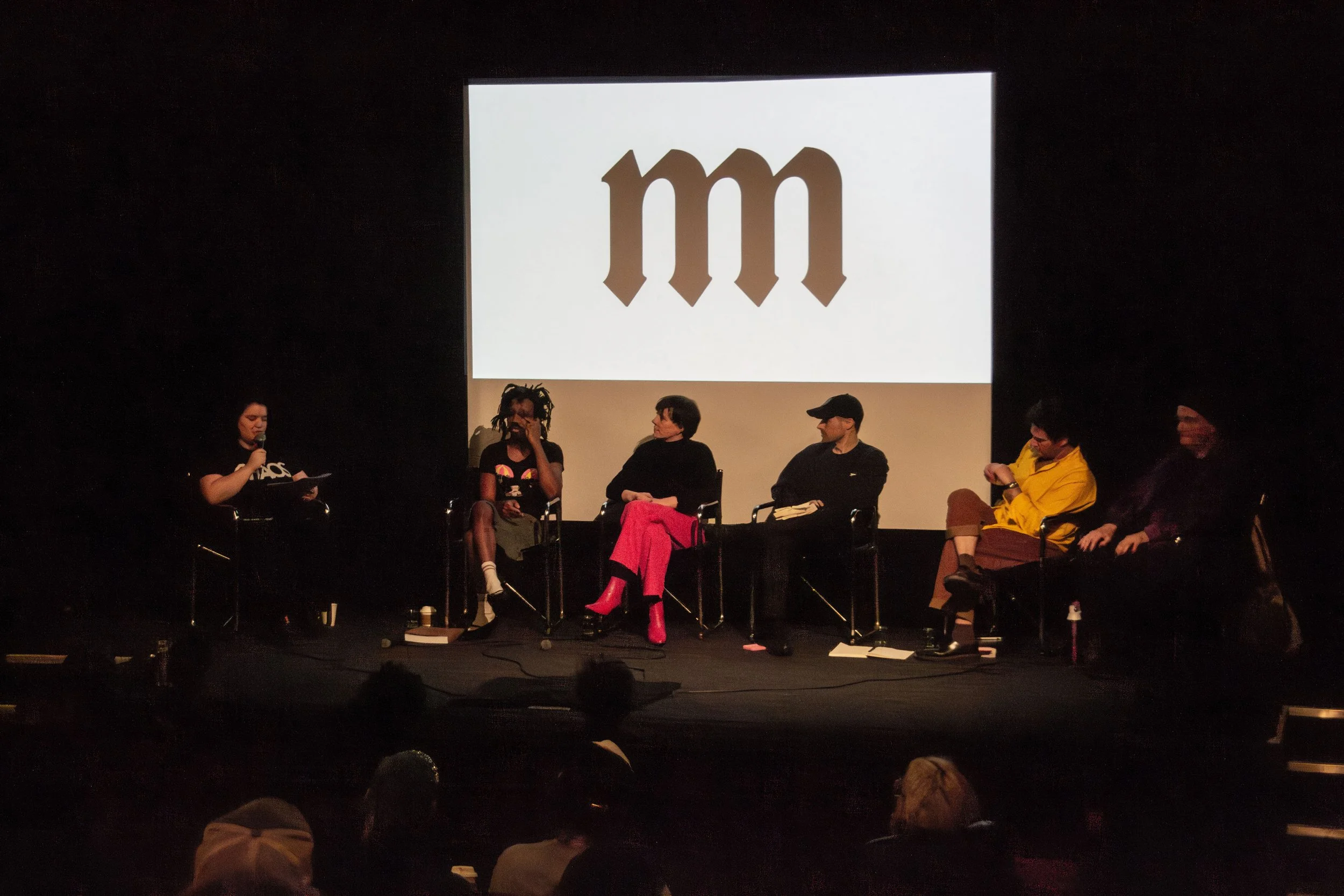
That's part of the radio programming – myself and Miranda Shutler curate the London branch of the radio programming. This year we’ve been doing a broadcasting series, which takes three to four different thematics that have been explored in audio over the time that we've been working with the radio, and solidified them.
The first one was on friendship, we broadcasted from Mexico, London and New York, all around the ethics of friendship and contemporary art and what that looks like; what is nepotism, what is genuine collaboration? The next one we did was Stand Up Fall Down, exploring the politics of irony and the irony of politics, political posturing within contemporary art, stand up comedy and how that functions. Manda and I commissioned a series of performances and talks at the ICA around this theme.
How do you approach curation at Montez Press?
Montez, as a whole, has an interest in queer, feminist and intersectional subjectivities as well as working-class artists, people who are working and are at the edges of subculture and at the edges of grassroots production. We think about what that looks like all around the world, and how we can facilitate an environment that connects, in a hyperlocal way, those grassroots communities. We have three really brilliant editors—Elida Silvey, Hasti, and Anja Dietmann (who directs Pfeil magazine)—who collaborate with me when commissioning.
Almost everybody at Montez and everyone who works with us are all artists first. It’s an artist led press. That's really something that's made the press what it is.
Every year we commission one artist book; currently we’re working on an artist book for Shola Von Reinhold, her first artist book (2026) and an artist book for Vivienne Griffin (2027). Both are very different yet highly innovative projects, but we were looking for something that challenges the form of what an ‘artist book' can be. Shola (author of LOTE) is exploring the history of the hermaphrodite figure in ceramics and painting, and how that figure relates to trans representation. Vivienne Griffin is using text as sculpture, looking at failure in language/the breakdown of language, and exploring how they have sampled mistranslations and colloquial aphorisms in their texts over a long period of time, thinking about how this methodology and cataloguing forms a thread through an artistic practice.
What's your process like when working with a commissioned artist?
When you're working with artists, you really work for them. Since I'm an artist, it's really easy to think – what would I enjoy or expect in an ideal world? How would I like this to be run? We try to tailor the experience to what somebody might need. We sit down with the artist at the beginning, ask them how they want to work, and offer the best option for them.
For example, somebody might need to go away for six months and just work alone. We then would pay them a stipend while they do that and do the work. Then we would have a few in-depth editorial sessions, a few back and forth draft rounds with our editor, before moving to work with the designers, go to print, and do a promo roll out.
The other way that we work is where somebody might want more collaborative support, which is the most fun for us, because that means we'll do workshops in the studio with them before they start working. They still receive a stipend to work on the project, but it becomes more of a generative conversation between all of us from the beginning, and the relationship to the editors is much closer.
What are the challenges around securing funding for an independent publisher?
My job as director involves a lot of fundraising. We've been very fortunate to receive philanthropic funding alongside public funding for a long time. However, submitting multiple funding bids per year is a lot of work, but it's worth it if it comes through.
At the moment, we're seeing arts funding shrink, globally. Artists are broke. Everyone's applying for the same pot and everything's oversubscribed. There isn't enough to go around, or rather, there is but it’s being held in increasingly small circles. The right-wing has successfully engendered a scarcity mentality.
Sometimes when you're in the quagmire of admin, raising money, and managing a lot of different projects at once, it’s easy to forget the reason why we do what we do. We're doing it because we want a community, a peer group who use their brains and think in a nuanced way about art and what's going on in the world, and push for artistic excellence. It's really important to remember that the reason we're in this is because we are people that want to connect, share wild ideas, and think critically.
We're doing it because we want a community, a peer group who use their brains and think in a nuanced way about art and what's going on in the world, and push for artistic excellence.
It feels vital to be publishing now, we're seeing such heightened censoring and dishonesty happening in mainstream media, so to have access to disseminating ideas via our own platform is essential.
What are some standout projects that you’ve worked on?
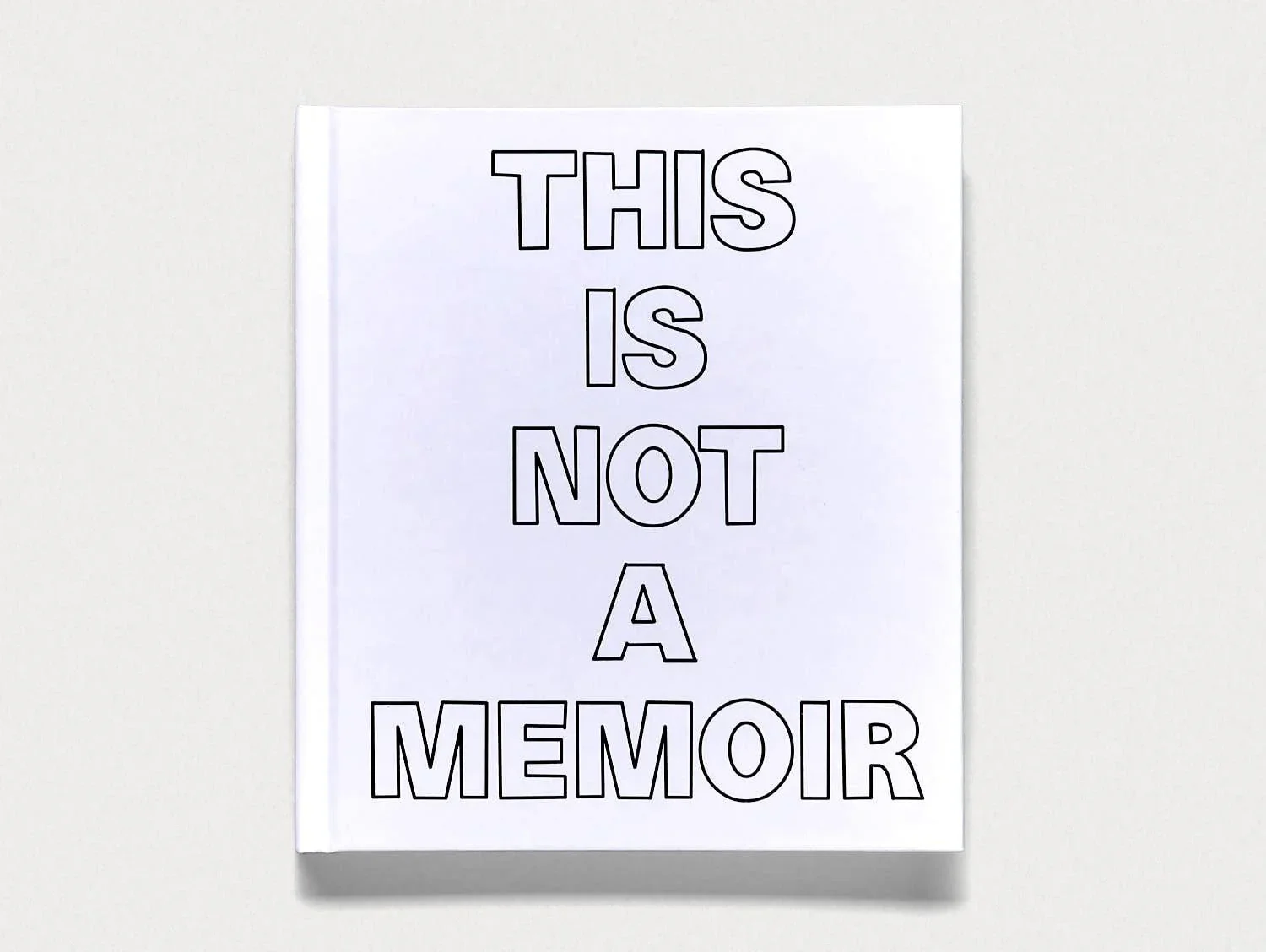
I loved working on a book called This Is Not A Memoir by Janette Paris, which was an artist's book narrating a journey through lost high-street landmarks of East and South London. There were amazing text pieces next to really intricate drawings of things that you wouldn't necessarily think of as cultural iconography, and then through this lens, were reinvigorated as such. Something that we love to do is remap a landscape according to the people who actually live within it, as opposed to what high culture says is happening there.
I’m also really enjoying commissioning Scores, a script / theatre based project in collaboration with London Performance Studios. We’ve never published performance texts before, so this feels super new and fun.
How did the visual identity at Montez come to be?
We have always worked with the same two designers who are also our art directors, Julian Mader and Max Prediger. One of our founding members, Anna Clark used post-its that she stuck all over the walls the first time we tried to broadcast the radio. The post-its had all the names of the shows we were broadcasting. Max and Julian turned that into what it looks like now. They design our books in collaboration with the artists that we work with, as well as being on board with our creative vision for the press since the beginning.
What is the importance of running an independent press in 2025 and beyond?
Being able to speak truth to power. Being able to programme in a way which doesn’t adhere to some bullshit hierarchy or money hierarchy that I don’t respect. Being able to work with a team of colleagues and peers I respect. Most importantly I feel it functions a bit like how I wish an art school could function, it sounds a bit glib, but we learn a lot working alongside one another.
What advice would you give to someone who is looking to get a start in publishing or an artistic practice?
My main advice would be to start your own project, do a fuck tonne of research and work really hard. Don’t wait for someone to let you into their environment, start something yourself instead. The most interesting projects come out of the space where you fail and experiment and don’t wait for anyone to give you something.
I had a somewhat unorthodox entry into everything. I've got a B-Tech, I don't have A-levels. I went to art school for my BA, then to School of the Damned, an alternative MA, then I did a writing master’s, even though I haven't got an English A-level. I then found my way into publishing because I’m totally obsessed with text-based artwork.
Emily Pope’s Book Recommendations
Brown Neon by Raquel Gutierrez
In the Dream House by Carmen Maria Machado
Interjection Calendar 10 edited by Rhea Dillon
Skint Estate: A Memoir of Poverty, Motherhood and Survival by Cash Carraway
Prairie, Dresses, Art, Other by Danielle Dutton
Jaw Filler by Maz Murray and Charlie Markbreiter
Walking Through Clear Water in a Pool Painted Black by Cookie Mueller
The Private Notebooks by Lee Lozano -
Bad Reputation: Performances, Essays, Interviews by Penny Arcade .
Memoirs of a Survivor by Doris Lessing
Maeve de Bordóns Álvarez is a writer based in London and of Spanish/Irish origin. She is the co-founder of independent music label and platform La Bonne Musique, and co-founder of La Sobremesa by MO: a supper club platorming diverse cultural interests . She is interested in learning new things every day.
