It was a warm Mexico City night, of all places, that brought me opposite prolific poet Poppy Cockburn; she sipped tequila, I complained over my heavily upset stomach, and we swapped notes and impressions of that marvelous, colourful city. We had serendipitously found ourselves travelling to Mexico at the same time, and despite having crossed paths at multiple poetry readings in London, this was our first proper one-to-one. Perhaps because of the closeness brought upon by witnessing someone in a faraway country, in that raw state brought upon either by indisposition (my case) or grappling with an unfamiliar language (her case), or perhaps because we simply got along, I’ve been following Poppy closer since that fortuitous encounter.
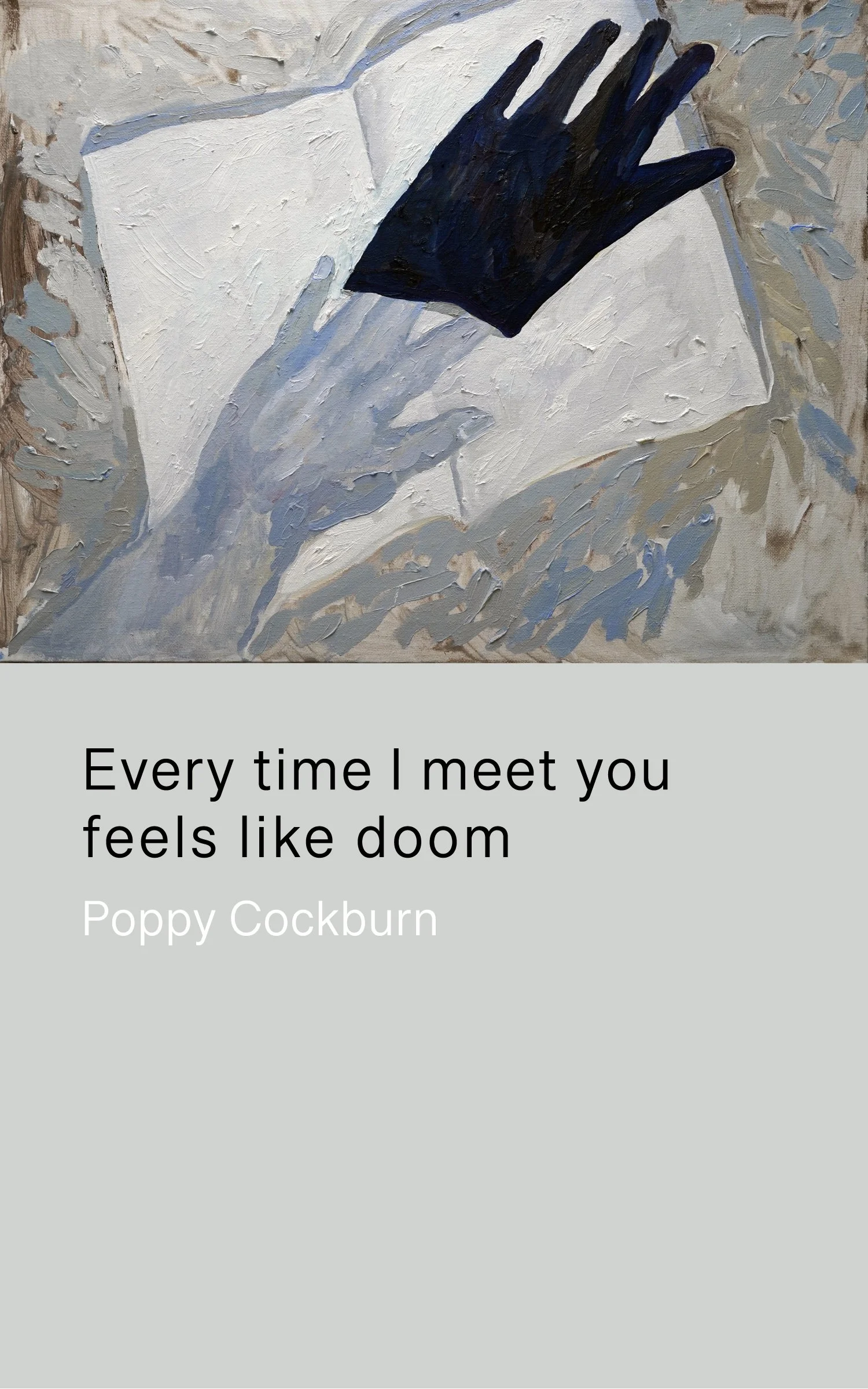
Every time I meet you feels like doom is, as we discuss below, Poppy’s third published work of poetry since 2025. The collection opens with the poem ‘Save, don’t save’ where “A crock of gold appears at the end of an endless scroll. Thank / fuck.” From the vicissitudes of posting and being online—cue cycle of: exposure, recognition, guilt—to lyrical, imagistic poems that draw from artists such as Baudelaire, Antony Gormley, Cindy Lee and Hieronymus Bosch (Bosch being a perfect distillation of Poppy’s poetry), doom is a collection of poems that are sickly sweet. A dirty mirror to catch glimpses of yourself in. A work of extreme precision.
Below we speak about why this has been such a prolific time for her, how she developed and finessed two poems previously published in Worms for the collection, and how poetry and posting on the internet are acts of self-performance.

Arcadia Molinas: Every time I meet you feels like doom is SARKA’s first poetry release. What was it like to work with Francesca Kritikos at SARKA, and what does it mean to you to be their first poetry release?
Poppy Cockburn: Working with Francesca has been an extremely collaborative and caring process, which I think is everything a poet publishing with a small press hopes for—someone you implicitly trust to champion your work and do right by you.
Perhaps it helps that she’s published her own poetry with small presses, which is how I first encountered her writing, through Feral Dove, and then Blush Lit, before realising she also ran an excellent online journal and press. There still aren’t enough women publishers out there as far as I can tell, so I’ve a deep respect for those challenging the status quo.
As for being SARKA’s first poetry release, it feels like a huge privilege and, to be totally honest, a bit of pressure, especially since I’m UK-based. I haven’t totally managed to escape imposter syndrome, but mostly I’m just filled with a sense of wild optimism and gratitude.
The supportive response so far has been lovely.
This is your third publication since 2025: you now have two full poetry collections and one more chapbook out in the world. What has made this such a prolific time for you?
Bad romance! It’s made for a rich source but I don’t endorse it. Life’s too short to keep entertaining people who fear love.
At Worms we published an earlier version of two of the poems in the collection, ‘Saint Sebastian’ and 'I break up with the kindest man I’ve ever dated'. Can you talk me through the process of revision, and if putting them in the bigger collection transformed the poems?
I’m always editing down, and for me, unnecessary lines and words reveal themselves as time goes on i.e. the longer they have to stew, the more they reduce. I didn’t change anything structurally significant in these poems—just lines I felt were distracting—whereas the poem titled Feather play underwent major surgery. It was originally a much longer sequence in fragments, with a different title. In the end, I decided to turn it into one poem. I think this transformation mirrors the metamorphosis represented in the painting sequence that inspired the poem—The Swan by Swedish mystic artist Hilma af Klint. I like that a poem can change, whether in the edit, the sequencing, the recital, or context. By becoming part of doom, I think the two poems Worms published have probably gained cumulative significance, but I'm glad to think they have iterations in other places worming their way around the world. I quite like thinking of poems as worms actually.
How do you go about sequencing a collection?
Ideally, by printing the poems out and laying them lovingly on the floor, so that you have a visual sense of how the poems speak to one another, but if you don’t want to waste the paper, printing the titles only and doing a small-scale version is a good cheat. Scrolling up and down, copy-pasting is not the one. Once I’ve worked out what the potential arc might be, I tend to find that new poems surface, so the process of sequencing is generative in and of itself. It’s also kind of like a puzzle, trying to piece together where things best fit.
“Poetry sometimes feels like a curse, but at others, it’s like I’m made of a thousand tiny trapdoors and I can choose which one to drop out through at any given second.”
Is there a poem in doom you’re especially resonating with at this moment?
I think ‘Empathy Dummy’ might be my favourite poem in the collection. I love reciting it aloud. At times, I’ve thought it’s the best and perhaps most crafted thing I’ve written, even though none of the places I sent it out to wanted it. It’s inspired by one of Antony Gormley’s sculptures in Margate where I live. I was interested in the way people relate to figurative sculpture, and the problem of excessive empathy and projection – something that, to me, feels gendered. Indirectly, the poem tries to test the difference between the representation of a male body in public vs a woman's. It's a poem of inversion: fantasy vs reality, male vs female, human vs representation, above vs below, seen vs unseen and the way these opposing tensions interrelate or conflict.
Can you remember writing your first poem?
No, I don’t think so, but I remember an exercise an English teacher gave us in secondary school, where she read out ‘stripped back’ lines from ‘Dulce et Decorum Est’ by Wilfred Owen and got us to recreate our own more lyrical versions before encountering the original. It was an interesting process that’s stayed with me.
If I had to assign a colour to your poetry it would be pink; if it were a drink, I’d make it orange wine; and if it were food it’d be a cinnamon roll. But something that stands out to me when I read your poems is your use of swear words, or bodily images next to sweet ones, like for example “Groping strawberries”. Can you talk to me about what that contrast, or language, offers you poetically?
You’re making me feel really hungry and thirsty!
I haven’t thought about this that much before. I definitely don’t see swear words as off-limits. I’m not interested in a poetics of niceness other than as parody. On a basic level, the imagistic or linguistic contrast creates friction, and friction can make a phrase memorable or prevent it from becoming predictable. I think I’m just trying to be realistic, though perhaps I’m more of a pervert than the average person. But I think some of my favourite poets often use startling pairings of high and low, synthetic and organic language and imagery that make you doublethink as a reader – Mary Ruefle, Karólína Rós Ólafsdóttir, Nadia de Vries, to name a few.
In ‘How to disenchant a fawn’ you write, “I’m not a capitalist/unless posting for a reaction is a form of fracking.” Do you think the same goes for writing a poem? Do you write poems for a reaction too?
Once it’s in the public domain, a poem is a performance on the page. I think it’s okay to demand attention if you entertain and/or engage. I don’t think all poetry warrants or even wants attention though. I’ve written plenty of poems I just needed to write down and won’t be inviting anyone to read, so I guess writing poems can simply and beautifully be a way to encounter and commune with the world. Emily Dickinson barely had a readership in her lifetime which is interesting to me, because I find the idea of a public context motivational in terms of improving. I don’t necessarily see the need for a binary between the public and private, but recently I’ve been journaling a lot. The writing quality is poor, and that’s how I know it’s just for me.
When I read doom, I felt like there was a restrained smile lurking behind the poems, a self-effaciousness of the voice that reveals just enough of herself while maintaining a veil of privacy. Is poetry an act of constraint or an act of freedom to you?
Oooh that’s interesting because some of the poems in this collection make me feel very exposed – far more so than in my previous book. But maybe the collection moves between states of dress and undress, as a self-protective measure. Perhaps that’s also my response to constraint and freedom – that they co-exist. Poetry sometimes feels like a curse, but at others, it’s like I’m made of a thousand tiny trapdoors and I can choose which one to drop out through at any given second.
“A poem is a performance on the page.”
There’s a poem I love in the collection called, ‘Why I had to leave the city’. The images are, line after line, fantastic (“leopard-print strollers”, “I am old enough to have museums”) so I wondered, what has moving away from the city done for your writing?
Thank you! Hmm, I cannot know what I cannot know. I only really got going with writing poetry a few years before I left London so it’s hard to track the change. But I do sometimes wonder what my life would be like if I hadn’t made the move to the coast. I wonder if there’s an audience for a new version of Sliding Doors that traces a poet who does/doesn’t leave the city and their wildly diverging verse. Netflix producers HMU!
What poem would you recommend to Worms readers?
‘At thirty-three I finally had the dream’ by Joe Dunthorne is a hilarious Oedipal poem from his Faber collection O Positive. I was shocked the first time I read it and found myself googling whether the poet’s mother was still alive. When I turned thirty-three, I re-read and was delighted by it. Now I enjoy reciting it to people when I’m out and about. It’s short but memorable, which is basically my favourite kind of poem.
Poppy Cockburn is a writer based in Margate. Her debut poetry book, Naked Oyster, published by If a Leaf Falls Press in 2025, was highly commended for the Forward Prize for Best First Collection. Her second collection, Every time I meet you feels like doom, is out now with SARKA.
IG: @tru_romank
Arcadia Molinas is the Online Editor of Worms Magazine and Publishing.
