What does a room for writing mean today? In a time where writing can happen anywhere —on our phone, on Substack, or in notebooks (as perhaps the only remaining private place for thinking in our culture)—and content consumed quickly pervades every screen, one question keeps circling: what purpose does a room for writing hold? In a time where we no longer need the space, but we also lack it more than ever, what do shared spaces for thinking, learning, writing, and making enable and open up?
The Writers’ Room in London aims to answer that question. Since it was founded in 2023, first as a writer’s residency in a former church in Islington, the project has been run by writer-curator Lu Rose Cunningham and writer-artist Simon Lewandowski (an old tutor and friend of Lu’s), and has steadily grown into a space for exhibitions, screenings, workshops, and eventually, countless readings. After developing the programme, they moved into a much larger space in a former bookbinding factory, which once also housed Pink Floyd’s recording studios. The Writers’ Room—with an emphasis on writers, plural—has grown an expanding community of writers and makers, but not without an end date. In October 2026, The Writers’ Room tenancy came to an end, and became a space with a form unknown: a space without a space. Its next room is yet to take shape. Perhaps a kitchen, perhaps a community centre, perhaps the walk and talk in-between, via the pub or park, perhaps it will turn into a gathering.
Lu and I met when we both did our Masters at GSA: me in Art Writing, her in Curatorial Practice. In many ways it made no sense that Lu wasn’t in the Art Writing course, as nobody was more art writing than her; hosting readings at Glasgow’s Godspeed Studio, inviting the likes of poet and publisher (of Bumper magazine) Leo Bussi; publishing poetry in SPAM Magazine and Pala Press; and running workshops at The Pipe Factory. At the same time, the curatorial focus on communal spaces and experiences felt inseparable from how Lu approached the world of words. Lu’s work could be framed as a curatorial practice of words. We have since worked together on writing letters, readings and the launch of my book on scent, Reports From The Nose (Lunchtime Gallery, 2026), which came together as an evening of readings at The Writers’ Room during last summer’s heatwave. The words in space encapsulated by summer sweat, perfumes and fragrant drinks.
Space, such an abstract word. It’s everywhere and nowhere, especially in a city like London, where real estate is a joke and communal rooms for culture are increasingly rare, or under threat. Speaking to Lu, our conversation searches for alternative understandings of what a space can be.
Ahead of putting the programme on pause, I spoke to the curator and writer about dog ears, allotments, and the page, as well as the importance of both private and shared spaces for writing. About the importance of good tech and rest. How clapping has a contagious effect. And how readings and workshops are really just another form of a party.
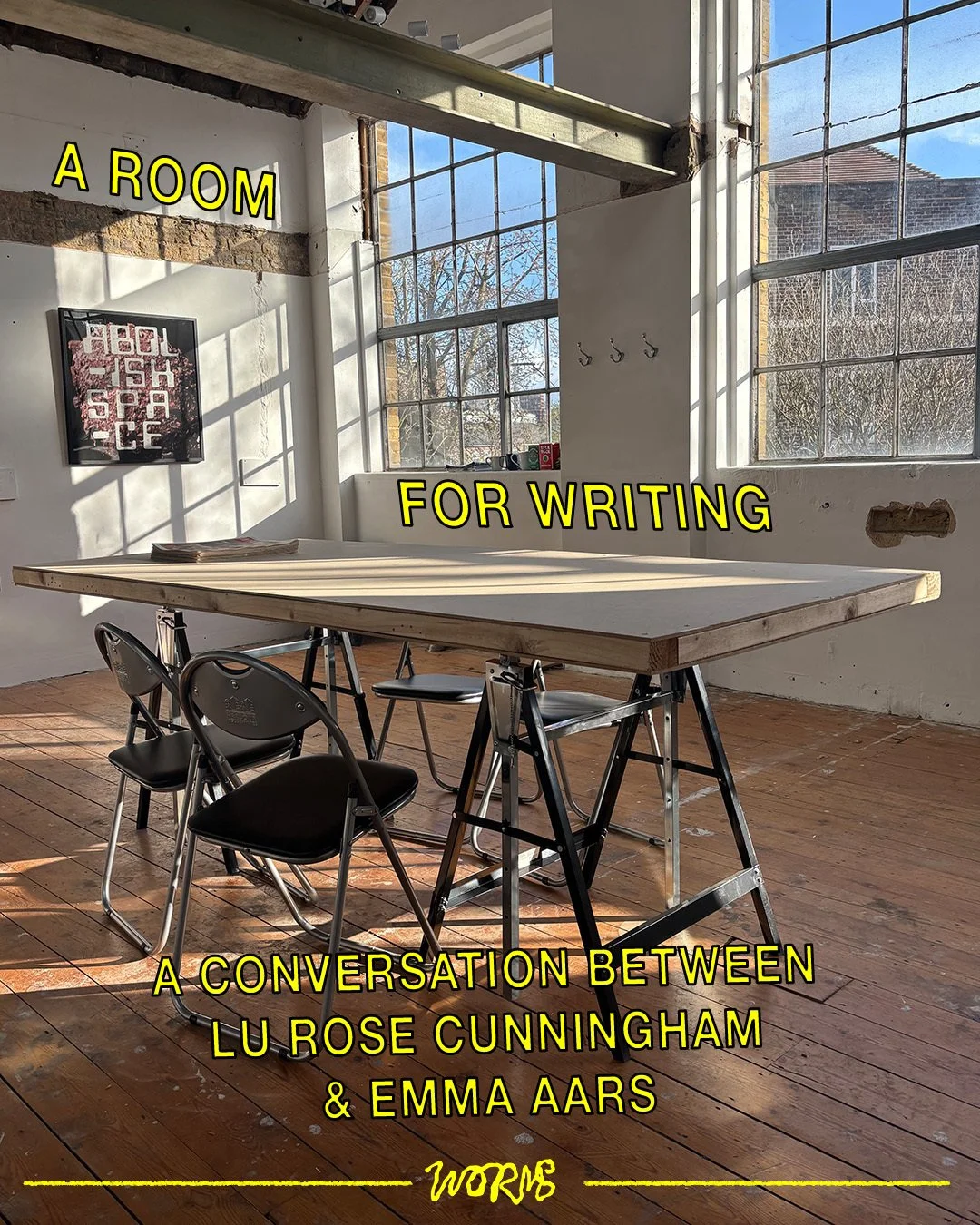
Emma Aars: It’s the final weeks of The Writers’ Room in its current space and form. How are you feeling?
Lu Rose Cunningham: It feels somewhat bittersweet. Our lease lasts until the end of October, and I'm trying to do as much as possible before we leave. The constraint has been helpful, and we have engaged with so many different practicioners—writers, filmmakers, playwrights, bookmakers, plus their friends and families—which has been lovely. But it’s obviously sad. In the three years we’ve been running TWR, this is the year that people have really started to engage with the programme. Loads of people have been reaching out lately, but at the moment we have no new building in mind.
Leaving the space, what are the main things you’ll take with you from these three years?
I’ve learned so much. Gathering people from different communities, making lots of friends – supporting lots of friends. This summer we had a writer come all the way from Toronto with her event series ORAL METHOD, and I want to go over and visit her at some point; Esmé shares a joy for hosting events too and I’d love to encounter the Canadian writing sphere. Overall though, I think I’m ready to take a moment to reset. I’m looking forward to running a more nomadic programme, and taking a step back from hosting on such a scale, looking after people and the warehouse itself. I’d like to structure and run a programme hosted by organisations that already exist, whether that is a gallery or library. For TWR to be in residence.
I think that naturally makes sense for what you’re doing. You want to be focusing on organising projects and events.
The building is important, but it’s what’s active inside, the practices, that counts.
It’s a shame when real estate becomes more important than the art it houses. I’ve been speaking to people in Glasgow about how GSA will not finance the renovation of the Mackintosh building because it’s so expensive, but you can’t help mourning that it’s such a big part of Glasgow’s heritage.
Especially with the CCA next door, a true loss of culture. [Ed: CCA was evicted last year and its contents sold off at an auction this year, including all the artworks donated by artists to the institution over the years]
It’s also the context of it. If the rest of the city was well-funded and flourishing culturally, it would have been different. But it seems like nobody has the intention of supporting the arts structurally.
There are so many amazing practitioners and spaces in Glasgow. But I worry about the infrastructure for the people living there. I was at a conference yesterday where they were questioning this idea of ‘care’ in curation, and some curators I know told me the same thing is happening in Leeds as in Glasgow, where the council is evicting artists, and wants to knock down the old buildings, only to build something new. Meanwhile, the artists are saying ‘we can renovate this place. We know how to do it and could make it into studios or communal spaces.’ But that easily turns into years of talking to the council, filling out forms, et cetera. That is more work for creatives too.
You know the people who run the Albert Road space in Glasgow, which is shared between several galleries? I think they have deliberately decided to not apply for funding and instead cover the costs between them, because there is so much time and paperwork associated with applications that it doesn’t really pay off.
It’s something I’m thinking about for the long term. Because I would really love to run a space, and after the conference yesterday, I’ve been seriously thinking about co-running it. A curator I really admire called Paul O’Neill was there, who runs a space called PUBLICS in Helsinki. During the Q&A at the end, I asked him how he self-organises and manages to keep it running with such a rich programme. And he responded that honestly, there are many arts workers involved: there is a board and the team he’s in, and that he wouldn’t be able to do it on his own.
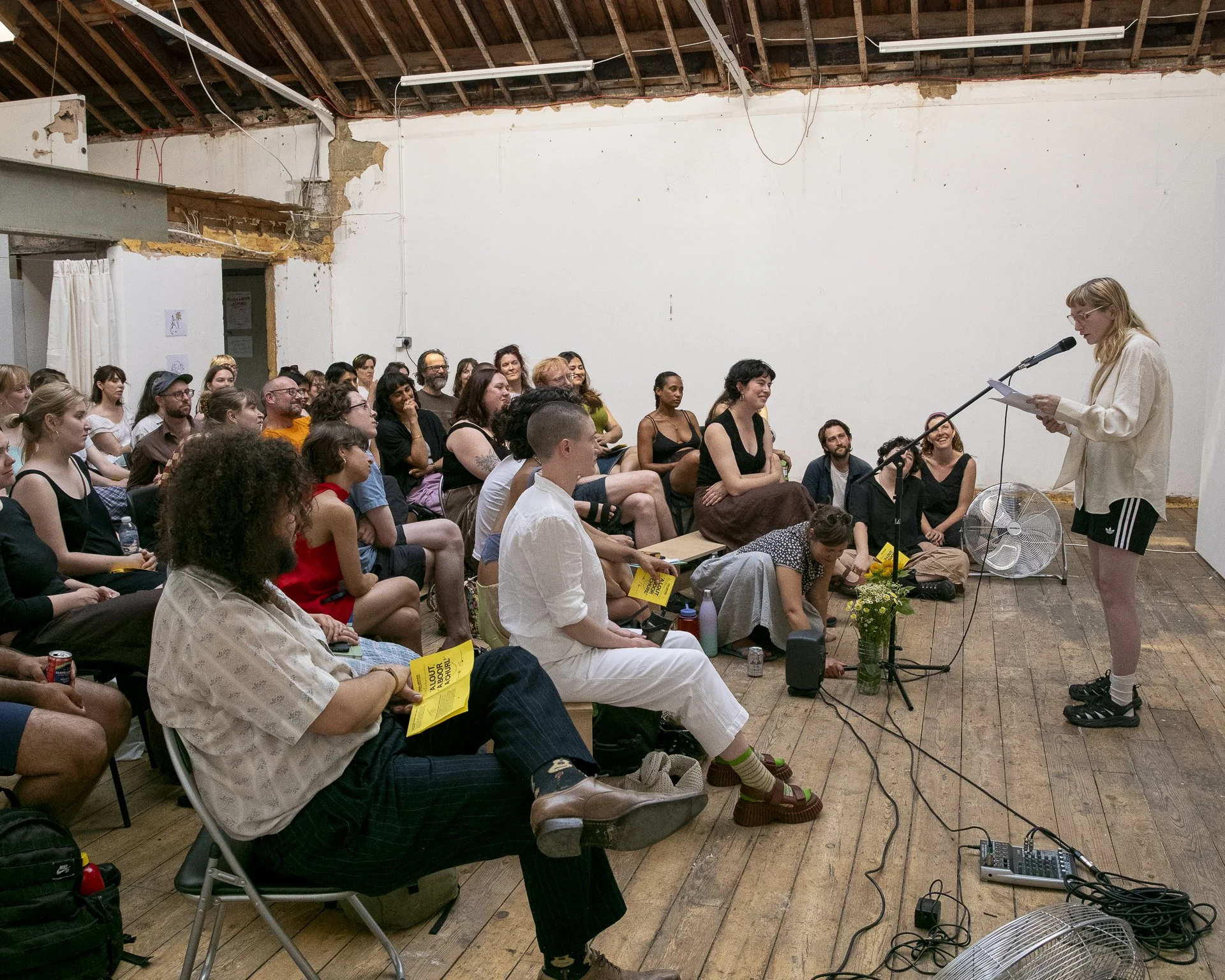
Reading event at The Writers’ Room with resident ORAL METHOD, Summer 2026. Photography credit Roman Sheppard Dawson.
“For writing, it’s helpful to have some sense of isolation, but there is a social aspect that is important, too. Whether that is just to talk through where your writing’s at or the early stages of planning an event, it brings your writing and research to life.”
I’ve been thinking a lot about how we treat writing as such a private thing. Either in this idea of ‘a room of one’s own,’ or the private relationship between writer and the page, then the reader and the page. So a room for coming together around writing feels so distinct, and feels so important.
I often think when someone says a space, how do you define that? I think a literal space is a privilege nowadays with rents and operational costs, but it is so valuable. Because it can manifest as a library, or reading room, a space to write, or become a site for film screenings, a cinema. A hub for dialogues, for praxis through proximity to others. And I do think people need it. Some people can’t afford studios or don’t have space at home for a desk. For writing, it’s helpful to have some sense of isolation, but there is a social aspect that is important, too. Whether that is just to talk through where your writing’s at or the early stages of planning an event, it brings your writing and research to life. It animates it.
You need the space to write, but you also need the space to activate yourself in a way that makes you want to write. At least I feel that I lose sense of my own writing if it stays only inside my own head.
I think there is an ego in writing. And that’s not a bad thing. I think people like to share what they have written, because it validates it. It gives it a sort of body, bringing into being through the writer’s voice, which you can then see externally, and with other people. I guess it’s a question of who are you writing for? Maybe you write for yourself, but a lot of the time you are writing for a reader, or listener.
Or maybe they don’t even know that they are writing for a reader, but it becomes apparent in the act of sharing it? The realisation that these words exist when there’s a person receiving it?
That is true. It’s not quite reciprocal, but there is a sense of giving and receiving – giving back thoughts, or even through the act of clapping there’s recognition, an acknowledgement. Feeling held, heard and seen.
“It’s not about the space being packed with people, but about arriving at a shared understanding.”
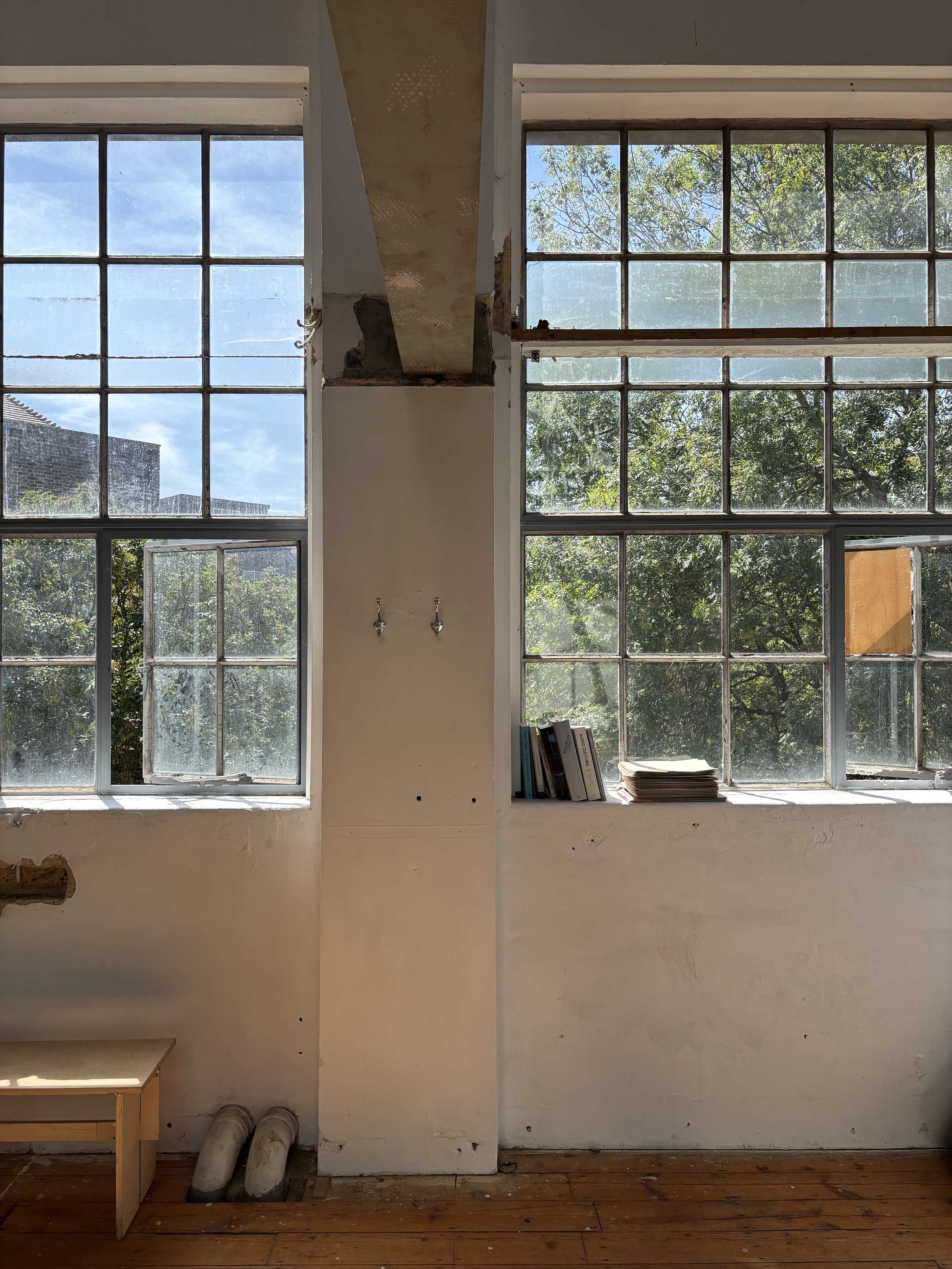
The Writers Room, Islington, Summer 2026. Credit Lu Rose Cunningham.
Do you ever have that, when you are listening to live recordings of music with clapping at the end, and you catch yourself joining in on the clapping? I love how contagious it is, seeking that shared experience.
Maybe the clapping itself, a tactile and sonorous act, is also something very special? There is something about having a group of people together engaging in something literary with such physicality.
I guess I was thinking about your book launch at TWR in preparation for this. How did it feel for you to have an audience and space for your work – especially with scent in relation to language? How was it to have people engage with the sensorial elements of the book, and take something away by taking the scent with them into their own lives? You had sprayed a chosen perfume on each front cover... Did the launch feel like it added something to your practice?
I’ve thought about the relationship between the private and public in both literature and scent. You wear a fragrance that holds memories and stories personal to you, but you also share it with the people you’re surrounded by, who may have their own way of experiencing the smell. I liked this element of the event – more than simply spraying perfume on the books, the sensory was activated in the space through the different types of readings, which were all evocative in their own way. We were giving smells a new language. It made me want to continue the format of scent-related readings, not just engaging with the subject, but with different people and approaches through the subject.
I think there was a collective intimacy through this shared exploration of scent, building up a bank of smells. It’s not about the space being packed with people, but about arriving at a shared understanding. It wouldn’t happen without a space to meet in. And there was the heatwave, which made everything very visceral, everyone was sweating. The whole evening, in a way, was very visceral, heady.
I think that’s the core joy of running TWR, to have people in the space. But I’m excited to see it evolve, in the intersection of visual art, text, performance, different practices – to be able to speak to and host people who are interested in these topics.
If finances and practicalities weren’t an issue, what kind of shape do you see your practice taking going forward?
I’ve been in conversations with a couple of bookshops, and library-community spaces, proposing doing a series of bi-weekly workshops. Those would be followed by quarterly events with a more formal lineup, and a sort of anchor point. Initially I’d start with writing and reading groups. Coming together is what people benefit from the most. Over time, I would also want a physical space, with shelves and communal tables. And a projector, PA, mics. I’ve come to realise the importance of good tech! At this moment though, I need to work on acquiring funding and planning the next year, continuing such conversations.
The other thought I’ve had, when the weather is nicer, is doing a series of readings in an allotment.
That makes me think of Derek Jarman’s diaries, where he writes in detail about different plants and flowers in his gardens, how they grow and die, alongside his own illness.
I love Derek's work Modern Nature, the garden and his practice coalescing as sites of stimulation, revisiting, attentiveness. It would not so much be a series about allotments, but the allotment as a space for sharing resources, writing holding potential, and growing. Growth that revitalises itself each year.
I’m looking to have a physical space eventually, but it doesn't need to be massive. Hosting, say, 20 people. I don't need big numbers. We’ve had events with 30 people, which felt packed, and I thought ‘this is enough of a crowd’. We did an event with 70 people earlier this year, and I don't really know what this proved beyond that there were more people there.
“Learning together like drinking, being convivial, with others. Being together, conspiring together: that is basically a party.”
The room, as being a space of togetherness, becomes a different experience with a smaller crowd. With a big crowd, you don't get the same feeling of being part of something.
When we started TWR, Simon and I ran a much smaller space. And immediately it would feel more contained, hold people in a closer way. We set it up as a space for work and research, and if the residents wanted, they could open the space up for public events. It was only because people were leaning into this invitation that the programme evolved. People also liked the feeling of being involved although they were not in residence. When we moved to the new space, the invitation grew, and it became this symposium in the sense that we were learning together. Symposium means together, to drink. Learning together like drinking, being convivial, with others. Being together, conspiring together: that is basically a party. This was a quite recent discovery. But I want the party to feel a bit more intimate again.
Almost like a kitchen party.
Maybe that should be the next format, to meet in kitchens!
I’ve been thinking about the next iteration of TWR, will it continue to be called The Writers’ Room? Or does it change form and get renamed? Or maybe it will be TWR — kitchen party edition.
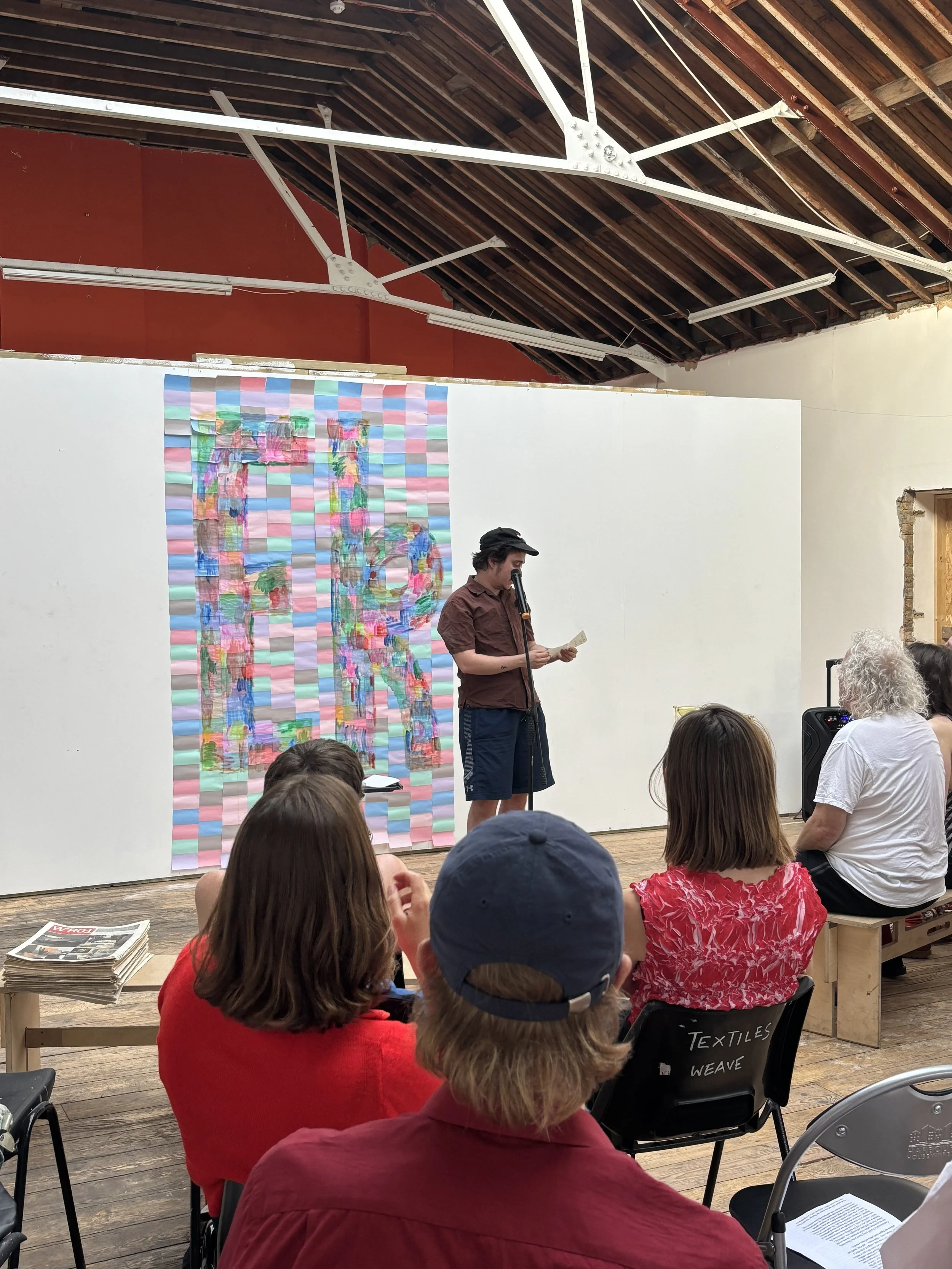
The Writers’ Room with resident Leo Bussi for his ekphrastic ‘Ek’ series, Spring 2026. Photography credit Lu Rose Cunningham.
The room can be quite a malleable container. It’s easy to think about a room as property, like, we have these 20 sqm, but it's actually more about the conceptual framework of a space, isn’t it?
Yes for sure, the malleability is key. I like the idea of, in time, shifting the name too, or calling a specific TWR event series ‘dog ears’.
Like, folding the corners of pages?
Savouring moments when you read, and the intimate touch of someone engaging with the page, with language, with something that has struck a chord. I dog-ear often! Savouring other people’s work, making a note of it, and making it your own in a way that isn’t stealing, but engaging in a tradition of collecting. Dog-ears as coming close, archiving, remembering. I imagine this future series or programme as a way of educating each other. Not as an alternative school exactly – but as a way where people can co-learn with attentiveness.
What else are you thinking about, going forward?
I want to be more gentle, go slow. A piece of advice someone gave me recently was, ‘when you start something new you want to go all in, then slow down’.
It affects the people you invite in, and how they interact with the program too. Like, what you were saying about the party: the unofficial space that happens after the reading becomes the main space. I don’t know if you’ve ever had that, but sometimes it's after doing an interview, after you turn off the recorder, that people start saying amazing things because they are just talking, not performing. Maybe a slower approach invites a similar openness, more ideas than an imposed expectation.
I have a friend who writes music, who always takes journalists to the same cafe near his flat because it helps them relax. Maybe there is something in that familiarity.
Please consider supporting The Writers’ Room by donating to their crowdfunder.
Emma Aars is a creative writer and editor based between Oslo and London. She holds a master's in Art Writing from Glasgow School of Art, and is the founder of Booking Service, a studio approaching creative publications as both idea and object. Recent publishing projects include 'Endless Europe' (Dinamo, 2026) , 'Picolissimo' (COSE, 2026) 'Shop & Save' (city, 2026), and 'Reports from the Nose' (Lunchtime Gallery, 2026).
Lu Rose Cunningham is a writer-curator, with a love of long walks and handwriting. Cunningham’s work has been presented at Leeds Art Gallery; South London Gallery; Wysing Arts Centre; The Barbican and SIZE MATTERS, Vienna. Cunningham has written for independent journals Pala Press; SPAM; MAP Magazine, JAWS, and WORMS and more. She is co-founder of London programme The Writers’ Room, supporting practitioners at the intersection of image and text.
