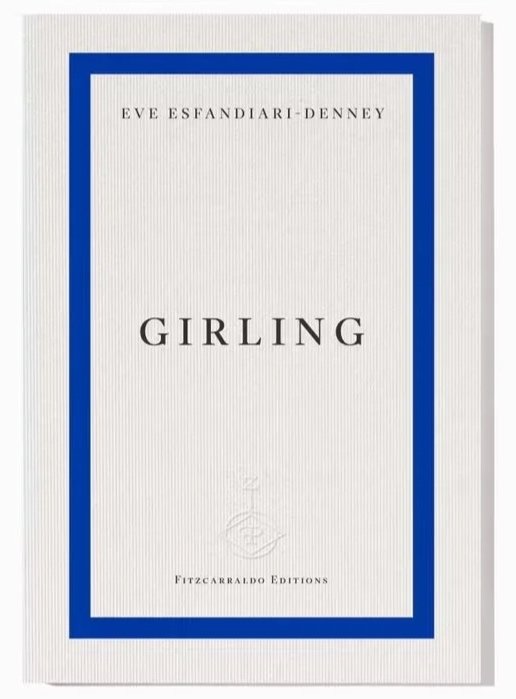
Girling, Eve Esfandiari-Denney’s debut collection, out now with Fitzcarraldo Editions, is a luminous meditation on the improbability of being alive. Speaking to contemporary life in all its weirdness and mundanity, grief, illness and an intimacy with death rub up against Esfandiari-Denney’s warm wit and quiet yet profound observations, taking us from “Nan's in Birmingham” to turning eleven and discovering the “numbing effects of humming”; from sipping on a LostMary to a “perfectly chilled rosé waiting for the world to burn behind us.”
For this first iteration in our new online series ‘Conversations with Poets’ I talk to Eve about the process of releasing the book, harnessing messiness into form, and her penchant for winged things.
Caitlin McLoughlin: Congratulations on the recent publication of Girling, it’s phenomenal. What has it been like to release it into the world?
Eve Esfandiari-Denney: I’ve been having recurring dreams about going outside with no trousers on, and throwing buckets of yogurt on my parents. I think I’m ok though.
I came to the Fitzcarraldo summer party where you read from the collection. Your editor at Fitzcarraldo, Rachael Allen, gave you the most beautiful, glowing introduction. What’s it been like working with Rachael on the book?
If you’ve ever felt invisibilised by life in any way, being edited by Rachael is a kind of profound remedy for that. Rachael has an amazing heart, and an equally amazing mind. When that combination is directed towards your writing it’s basically a miracle. Also, she really knows how to get a book finished. She veered me towards the direction the work was meant to go in constantly. Her capacity to move between the micro and the macro of a manuscript is kind of shamanaic. I’m describing her like a religious figure but really she’s a historical one. She also laughs very loudly which I LOVE.
When did you know that Girling was a book? Did you set out to write a book from the beginning, or did you consolidate poems retroactively?
I lived with the manuscript for a long time, some parts are nearly ten years old. I suppose it felt like an actual book by the final edit, but even then I wasn't sure. I overwrote a lot, and some poems required a lot of reworking, some not too much. To answer your question directly, I have no idea when something is officially a book.
Your references in Girling are broad and varied. For example, your poems borrow from the wisdom of Claudia Rankine, Anne Carson, Hailey Bieber and Emma Chamberlain. The way they are constructed from a composite of ideas, speech, other poetry, makes them feel like ways of reading the world. Or, like the way people think dreams are our brains' way of filtering through everything we’ve experienced while we are awake and filing away the things it wants us to remember. Is poetry a way of making sense of things, of holding onto the things you want to remember? Where does a poem begin for you?
Poetry as a whole I can't speak for, but lyric poetry seems to create a particular intimate triangulation between reader, poet and speaker. It’s a sort of shared subterranean knowledge, or permission to sense rather than know each other. I think of lyric as starting there, at whatever affect is cultivated in this curious and mercurial gulf between yourself and another.
“It’s hilarious to carry a little life around with such weight, but I do. That's not to say my littleness isn’t miraculous, but I am still little. The grandiosity of poetry itself has similar contrasts.”
Where do you write best?
I write best in my dad’s static caravan in a tiny coastal town called Peacehaven. The caravan is right on the edge of a cliff by the sea and has no wifi. It also has a little dishwasher which makes the whole experience run very smoothly.
Can you remember writing your first poem?
Yes! It was awful. Something about being in a chemo chair and feeling like a big bird which is basically what Girling articulates, actually.
Phoenixes, chickens, angels, sun birds – winged creatures recur across the book. What draws you to them?
I feel a strong affinity with birds because they often have a gammy leg, particularly chickens. When I was having chemotherapy for my leg as a child, there was a chicken on the news who had a leg tumour. She was the first chicken ever to have radiotherapy. She was called ‘Eve’ and her owners had the last name ‘Denney’. You can google Eve Denney the chicken if you don't believe me. I imagine she's dead now though… I’m not sure how long chickens live for. But anyway, perhaps it began with her. And also having chemotherapy in central London, there were so many limping birds outside.
Grief and illness are persistent themes throughout Girling and they are one of the ways the book is deeply personal. Has writing poetry been cathartic for you? Is it an act of freedom, or one of constraint?
If my writing is feeling cathartic it’s often a sign the writing is becoming a mess. I try to find this very specific distance from feeling that doesn’t stray too far away from myself, but doesn’t get too close either. That’s when I can implement both craft and feeling at once. It’s a kind of measured dissociation from feeling if anything. I don't find this to be a cathartic act, it’s more a way of harnessing messiness into form. In a lot of ways it doesn't feel like a personal book because of that. Giving form to experience means you must omit so much orbiting information, but then I suppose in doing that you tend to a particular strand of sense very thoroughly. Maybe that's the catharsis? The ability to version events.
“If my writing is feeling cathartic it’s often a sign the writing is becoming a mess.”l
Amongst this, Girling manages to be very funny. How do you arrive at this sense of levity amongst the complex and painful themes the book explores?
There’s nothing funnier than seriousness colliding with unseriousness. Like Marnie from Girls when she endeavors to become a singer-songwriter. My own mission through life feels similar. I describe myself as ‘busy’ like I’m not completely inconsequential. It’s hilarious to carry a little life around with such weight, but I do. That's not to say my littleness isn’t miraculous, but I am still little. The grandiosity of poetry itself has similar contrasts. Born out of this bizarre wine swilling tradition, it really can articulate the ineffable sometimes. Meanwhile, culture (at large) isn't asking for it. I love this as an entry point into baring your own vulnerability, I think it’s so funny, so courageous, so Marnie from Girls.
Romani and Farsi words and phrases are used in the book. I’m particularly thinking of your poem ‘I will eat your liver’ which comes from a Farsi phrase that means to yearn. What do other languages open up for you in your writing?
I think learning words in Farsi or Romani is how I piece together a sense of who my parents were and who they came from, and how I try to vaguely place roots in the world. Romani people call a hedgehog a ‘hotchi-witchi’. I’ve read they are meant to be the spirit animal of the Romani community. It’s somehow comforting to know that, and also be able to recite this estranged but ancestral word, to be able to hold the word ‘hotchi-witchi’ in my mouth.
Can you recommend a poem for us?
Great question. I would recommend any poem from K Patrick’s Three Births.
Eve Esfandiari-Denney’s debut poetry pamphlet, My Bodies This Morning This Evening, was published by Bad Betty Press in 2022. She has been shortlisted for the White Review Poet’s Prize, Aesthetica’s Creative Writing Award, the Forward Prize for Best Single Poem (Performed) and longlisted for the National Poetry Competition. Her work has appeared in The Poetry Review, Granta, BBC Radio 4 and Prototypes Annual Anthology, among others. Girling is her first collection.
Caitlin McLoughlin is an editor, writer and designer. She is a Director and Editor at Worms Magazine and Publishing. Her work has been featured in It’s Nice That, AnOther and Mag Culture. She is from Leeds but now lives and works in London.
